
Phone: +91 81307 87194
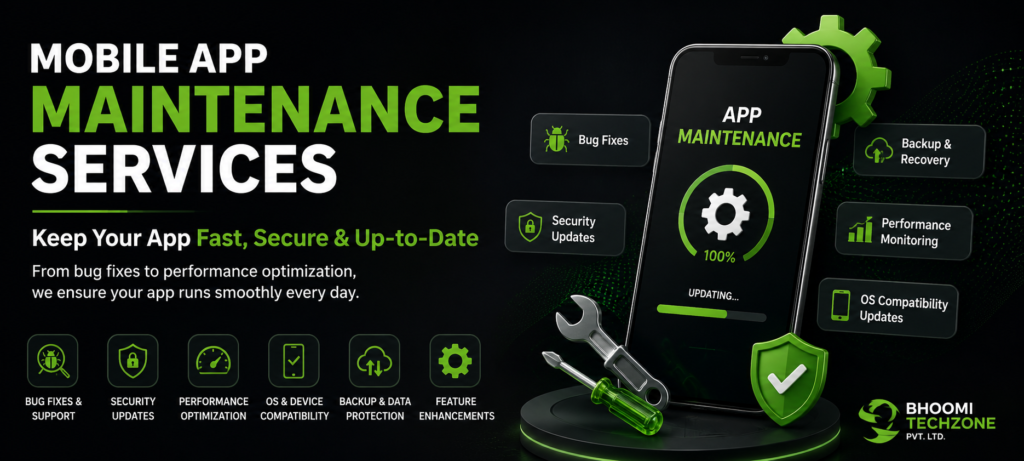
Mobile app maintenance services cover bug fixes, security updates, performance optimization, OS compatibility updates, and third-party API maintenance for apps already in use. Most apps need ongoing attention because operating systems, devices, and integrations keep changing even after the app itself is finished.
Launching an app usually feels like the finish line. It isn’t. A working Android or iOS build today can start crashing in a few months simply because Google or Apple pushed an OS update, a payment gateway changed its API, or a third-party library the app depends on quietly stopped being supported. This is exactly the gap mobile app maintenance services are meant to fill – not building something new, but keeping something already live actually working.
This article walks through what these services typically cover, what drives cost, and what to look for when choosing a provider, without treating maintenance as an afterthought tacked onto development.
What Are Mobile App Maintenance Services?
Mobile app maintenance services refer to the ongoing technical work needed to keep a live app functional, secure, and compatible with new devices and operating system versions. This includes fixing bugs users report, patching security vulnerabilities, updating the app for new OS releases, and monitoring performance so the app doesn’t slow down or crash unexpectedly over time.
Unlike development, which has a clear start and end, maintenance is continuous by nature – new OS versions release every year, devices change, and third-party services the app relies on get updated or deprecated on their own schedule, whether the app owner is ready or not.
Why Does a Mobile App Need Maintenance After Launch?
An app that worked perfectly at launch doesn’t stay that way automatically. A few realistic examples explain why:
- An OS update changes how permissions work, and a feature that used to run smoothly suddenly breaks
- A payment gateway updates its API, and checkout stops processing transactions correctly
- A third-party library the app depends on becomes outdated, creating security exposure
- Growing user numbers reveal performance issues that weren’t visible during initial testing
- A new phone screen size or device type causes layout problems that weren’t an issue before
None of these mean the original development was done poorly. They’re simply the normal cost of running software in an environment that keeps shifting underneath it – which is precisely why mobile app maintenance and support services exist as an ongoing category, not a one-time service.
What Is Included in Mobile App Maintenance and Support?
A reasonably complete maintenance package typically covers:
- Bug fixes and troubleshooting for reported issues
- Security patches and vulnerability fixes
- OS compatibility updates for new Android and iOS versions
- Performance monitoring and optimization
- Third-party API and integration maintenance
- App store and Play Store listing updates
- Minor feature adjustments and UI fixes
- Regular technical health checks
Some providers offer all of this as a bundled retainer. Others break it into separate services, so it’s worth confirming exactly what’s included before assuming a quote covers everything on this list.
App Bug Fixing and Technical Troubleshooting
Bug fixing is usually the most visible part of app maintenance services, mainly because it’s the part users notice directly – a crash, a button that doesn’t respond, a screen that doesn’t load correctly.
A reasonable troubleshooting process usually looks like this: reproducing the issue reliably, identifying the root cause rather than just patching the symptom, testing the fix across relevant devices and OS versions, and releasing an update without introducing new problems in the process. Skipping the root-cause step is a common shortcut that often causes the same bug to resurface in a slightly different form later – one reason bug fixing is rarely treated as a standalone task within proper mobile app maintenance services.
Security Updates and Vulnerability Fixes
Security is one of the areas where skipping maintenance carries real risk, not just inconvenience. Best practices for mobile app security updates generally include:
- Regularly updating third-party libraries and SDKs to patched versions
- Monitoring for newly disclosed vulnerabilities affecting the app’s tech stack
- Reviewing how user data is stored and transmitted
- Testing authentication and payment flows after any security-related update
- Applying platform-level security recommendations from Google and Apple promptly
Apps handling payments, personal data, or login credentials carry more exposure here than a simple informational app, which is usually why security-focused maintenance gets prioritized first when budgets are limited.
Android and iOS App Maintenance: Similar, But Not Identical
Android app maintenance and iOS app maintenance overlap in purpose but differ in practice. Android involves testing across a wider range of device manufacturers, screen sizes, and OS versions, since Android updates roll out unevenly across devices. iOS maintenance tends to revolve more tightly around Apple’s yearly OS release cycle and stricter App Store review requirements for updates.
An app available on both platforms generally needs maintenance planned for each separately, even when the underlying codebase is shared, since platform-specific issues rarely show up identically on both sides.
App Performance Optimization
A functional app that’s slow eventually gets uninstalled, regardless of how useful it is. App performance optimization as part of ongoing maintenance typically involves:
- Reducing app load and screen transition times
- Optimizing image and asset sizes without hurting visual quality
- Cleaning up outdated or inefficient code introduced during earlier development phases
- Monitoring crash reports and memory usage over time
- Testing performance on lower-end devices, not just flagship phones
Performance issues often build up gradually rather than appearing all at once, which is part of why periodic monitoring – one of the more routine parts of mobile app maintenance services – catches problems earlier than waiting for user complaints to pile up.
Third-Party API and Integration Maintenance
Most apps depend on external services – payment gateways, maps, SMS or OTP verification, analytics tools, social login. Each of these can change independently of the app itself, and when they do, the app needs to be updated to keep working with them.
A payment gateway changing its authentication method, for instance, can silently break checkout until someone notices and updates the integration. This is one of the more overlooked parts of mobile app maintenance and support services, since it’s easy to assume third-party integrations will just keep working indefinitely once set up.
App Store and Play Store Updates and Compatibility
Both Apple and Google periodically change their review requirements, target SDK version rules, and policy guidelines. An app that isn’t updated to meet current requirements can eventually get flagged, restricted, or removed from the store entirely – even if the app itself still technically works fine for existing users.
Staying compatible means periodically updating the app’s target SDK version, reviewing store policy changes, and testing against new OS betas before they become the public release, rather than reacting only after something breaks.
How Often Should a Mobile App Be Maintained?
There’s no single fixed schedule, but a reasonable rhythm looks roughly like this:
- Monitoring – ongoing, checking crash reports and performance data continuously
- Minor updates and bug fixes – as issues are identified, typically within days to a couple of weeks
- OS compatibility updates – aligned with major Android and iOS release cycles, usually once or twice a year
- Security reviews – at least quarterly, more often for apps handling sensitive data
- Full technical health check – roughly every 6–12 months
Apps that go a year or more without any maintenance activity tend to accumulate multiple smaller issues that eventually require a larger, more expensive fix all at once – which is really the core argument for treating mobile app maintenance services as routine rather than reactive.
How Much Do Mobile App Maintenance Services Cost?
Pricing varies based on several factors: app complexity, number of platforms supported, how many third-party integrations exist, and whether maintenance is billed as an ongoing retainer or per-incident. A simple app with minimal integrations costs less to maintain than a complex app handling payments, real-time data, or multiple third-party services.
There’s no single flat number that applies across every app, which is why a reasonable provider should review the app’s actual complexity before quoting a monthly or annual cost for mobile app maintenance services, rather than offering one generic rate for every client.
Affordable Mobile App Maintenance Packages
Affordability doesn’t have to mean cutting corners on security or reliability. A reasonably structured, affordable mobile app maintenance package usually separates work into tiers – basic monitoring and bug fixes at a lower cost, with more comprehensive coverage (performance optimization, proactive security reviews, faster response times) available at a higher tier.
Businesses on a tighter budget can often start with essential coverage – security patches and critical bug fixes – and expand into fuller maintenance as the app’s user base and revenue grow.
What Are the Best Mobile App Maintenance Services?
Rather than chasing a “best” label, it’s more useful to check for these specifics:
- Clear response times for critical issues versus minor ones
- Experience with both Android and iOS maintenance, not just one platform
- A documented process for testing updates before release
- Transparent reporting on what was fixed, updated, or monitored each period
- Willingness to explain technical issues in plain language, not just jargon
A provider that scores well across these is a reasonable candidate for reliable mobile app maintenance services, regardless of how they market themselves.
How to Choose a Reliable Mobile App Maintenance Company
A few practical questions help separate genuinely capable providers from ones offering surface-level coverage:
- Can you walk me through your process for testing an update before release?
- How quickly do you respond to critical bugs versus minor ones?
- Do you handle both Android and iOS, or specialize in one?
- What’s included in a standard maintenance retainer, and what’s billed separately?
- Can I see an example of how you report maintenance work to clients?
Vague or evasive answers to these questions are usually a bigger warning sign than any pricing detail.
Common Mobile App Maintenance Mistakes
A lot of the problems apps run into after launch trace back to a handful of avoidable gaps in how mobile app maintenance services are approached:
- Treating maintenance as optional once the app is stable
- Ignoring OS compatibility updates until the app starts breaking for users
- Skipping security patches because “nothing has gone wrong yet”
- Not testing updates across multiple devices before release
- Assuming third-party integrations will keep working indefinitely without monitoring
Mobile App Maintenance Services in India
Indian businesses running apps face a few specific practical realities worth planning for: a wide range of Android device models and OS versions in active use, growing reliance on UPI and local payment gateway integrations that update frequently, and increasing user expectations around app speed on varied network conditions.
Ongoing app updates, ongoing security maintenance, and monitoring for third-party API changes matter as much for Indian businesses as anywhere else – the core need for scalability and consistent technical support doesn’t really change by region, though the specific integrations and device diversity involved often do.
How Mobile App Maintenance Services Relate to AI Search
Search behavior has shifted, and this affects how businesses now research mobile app maintenance services too. People increasingly ask AI assistants direct, specific questions – “what does app maintenance include,” “how much does it cost” – expecting clear factual answers rather than vague marketing copy.
Maintaining an app after launch matters for a simple reason: users judge an app by how it performs today, not how well it was built at launch. Bug fixes, security patches, compatibility updates, and performance monitoring directly affect whether an app stays usable as devices, operating systems, and user expectations continue to change. Clearly structured, factual content about this process tends to be easier for both readers and AI search tools to understand and reference accurately – though no provider can guarantee specific AI citation or ranking outcomes from that alone.
Businesses evaluating providers commonly ask similar practical questions before committing – what’s included, how fast issues get resolved, whether both platforms are covered, and what ongoing cost to expect. Addressing these clearly, rather than with vague reassurance, tends to be what actually helps a business make a decision.
Where Bhoomi Techzone Fits Into This
Bhoomi Techzone supports businesses with mobile app development alongside ongoing mobile app maintenance services, covering updates, bug fixes, performance improvements, OS compatibility, and technical support for both Android and iOS apps. The approach starts with understanding the app’s current state and existing issues before recommending an ongoing maintenance structure.
This work often connects with broader technology needs, since apps rarely exist in isolation from a business’s website or backend systems. For companies also managing related infrastructure, this ties in with Website Development and IT Consulting services, since integration and compatibility issues frequently span across multiple systems rather than staying contained within the app alone.
As with any maintenance arrangement, outcomes depend on the specific app, its complexity, and how it’s used – this isn’t presented as a guarantee against every possible technical issue, but as a structured way to catch problems early and keep an app functioning as its environment continues to change.
Frequently Asked Questions
What are Mobile App Maintenance Services?
Ongoing technical work – bug fixes, security updates, performance monitoring, and compatibility updates – that keeps a live app functional as devices, operating systems, and third-party integrations continue to change after launch.
What is included in mobile app maintenance and support services?
Typically bug fixing, security patches, OS compatibility updates, performance optimization, third-party API maintenance, and app store listing updates. Exact scope varies by provider, so it’s worth confirming what’s included in a given package.
What are the best Mobile App Maintenance Services?
Rather than one universal answer, look for clear response times, experience across both Android and iOS, a documented testing process, and transparent reporting – these matter more than any single label.
Are Mobile App Maintenance Services available in India?
Yes. Providers across India, including Bhoomi Techzone, offer maintenance services covering Android and iOS apps, along with support for common integrations like UPI and local payment gateways.
How much do Mobile App Maintenance Services cost?
Cost depends on app complexity, number of platforms, and how many third-party integrations exist. A reasonable provider should assess the app before quoting a monthly or annual maintenance cost.
Are affordable mobile app maintenance packages available?
Yes, many providers offer tiered packages – basic coverage for critical bugs and security patches, with more comprehensive plans available as the app’s needs grow.
How do I choose a reliable mobile app maintenance company?
Ask about their testing process before releasing updates, response times for critical issues, experience with both platforms, and how they report completed work. Clear, specific answers are a good sign.
What are the best practices for mobile app security updates?
Regularly updating third-party libraries, monitoring for newly disclosed vulnerabilities, reviewing data storage and transmission practices, and testing payment or login flows after any security-related change.
Do companies offer app bug fixing services separately from full maintenance plans?
Yes, some providers offer bug fixing as a standalone service, though bundling it with broader maintenance often catches related issues that a narrow bug-fix-only approach might miss.
How often does a mobile app need maintenance?
Monitoring should be continuous, with bug fixes as issues arise, OS compatibility updates aligned with major platform releases, and a full technical review roughly every 6 to 12 months – the general rhythm most mobile app maintenance services follow.
Do Android and iOS apps require different maintenance?
Yes, to some extent. Android maintenance involves testing across more device variations, while iOS maintenance follows Apple’s stricter, more predictable annual update cycle and review requirements.
Why are mobile app maintenance services important after launch?
Because operating systems, devices, and third-party services keep changing after an app goes live. Without ongoing maintenance, even a well-built app gradually becomes less reliable, less secure, and less compatible over time.
Final Thoughts
An app’s launch is really just the starting point of a much longer relationship between the app and the environment it runs in – devices, operating systems, and third-party services that keep evolving on their own schedules. Mobile app maintenance services exist to manage that ongoing reality, rather than treating a finished build as something that stays finished forever.
If you’re evaluating your current app’s maintenance needs or planning ahead for a new build, the Bhoomi Techzone team is happy to walk through what that would actually involve – no pressure, just a practical conversation about what your app needs.
Written by: Bhoomi Techzone Content Team
Reviewed by: Senior SEO & Digital Marketing Consultant
Name: Bhoomi Techzone Pvt. Ltd.
Phone: +91 81307 87194
Address: A-43, A Block, Sector 63, Noida, Uttar Pradesh 201301
Website: https://bhoomitechzone.com/
Contact: https://bhoomitechzone.com/contact-us/