Phone: +91 81307 87194
Quick Answer: IT solutions for traditional industries include inventory tracking systems, production monitoring tools, mobile apps for field coordination, and cloud-based record keeping designed to fit existing operations rather than replace them entirely. The goal is reducing manual friction – not forcing a business to abandon processes that already work.
A garment manufacturer in an industrial cluster still counts finished pieces by hand at the end of each shift, then phones the numbers to the owner every evening. A wholesale trader running a family business for three generations keeps supplier ledgers in physical registers, some going back over a decade. A construction site supervisor coordinates material deliveries through a mix of phone calls and paper delivery challans that occasionally go missing. None of these businesses are doing anything wrong – they’re running on systems that worked fine at a smaller scale and are now straining under growth. IT solutions for traditional industries exist to ease that strain, gradually, without asking a business to throw out decades of working knowledge.
This article looks at how technology actually fits into industries like manufacturing, textiles, construction, agriculture, and family-run trade businesses – not as a wholesale replacement of tradition, but as a practical layer added on top of it, which is the core idea behind genuinely useful IT solutions for traditional industries.
Table of Contents
Why Traditional Industries Often Struggle With Digital Transformation
A few recurring reasons explain why technology adoption moves slower in these sectors compared to, say, a tech startup:
- Decades of institutional knowledge exist in people’s heads and paper records, not digital systems
- Owners and senior staff are often more comfortable with proven manual methods than unfamiliar software
- Many software vendors design generic tools around office-based businesses, not factory floors or farms
- Budget is often tied closely to production cycles, making software spending feel riskier
- Past bad experiences with overpromised, underdelivered technology projects create lasting hesitation
None of these are unreasonable concerns. They’re the natural result of businesses that have survived for years by trusting what works, rather than chasing every new tool that appears – which is exactly why IT solutions for traditional industries need to be introduced differently than in a typical office environment.
What Makes Technology Adoption Different for Traditional Businesses
Adopting IT solutions for traditional industries isn’t the same exercise as a software company rolling out a new internal tool. The workforce may include people who’ve never used a computer daily, the physical environment might involve dust, heat, or intermittent internet, and the business often can’t afford downtime during a transition. Any solution introduced has to work around these realities rather than assume ideal office conditions.
This is why the more successful technology rollouts in these sectors tend to be narrow and specific – solving one clear problem well – rather than ambitious, all-encompassing systems introduced all at once. That narrower approach is really the defining trait of practical IT solutions for traditional industries.
Real Operational Areas Where IT Creates Value
Rather than a vague promise of “digital transformation,” it helps to look at specific operational areas where technology consistently proves useful:
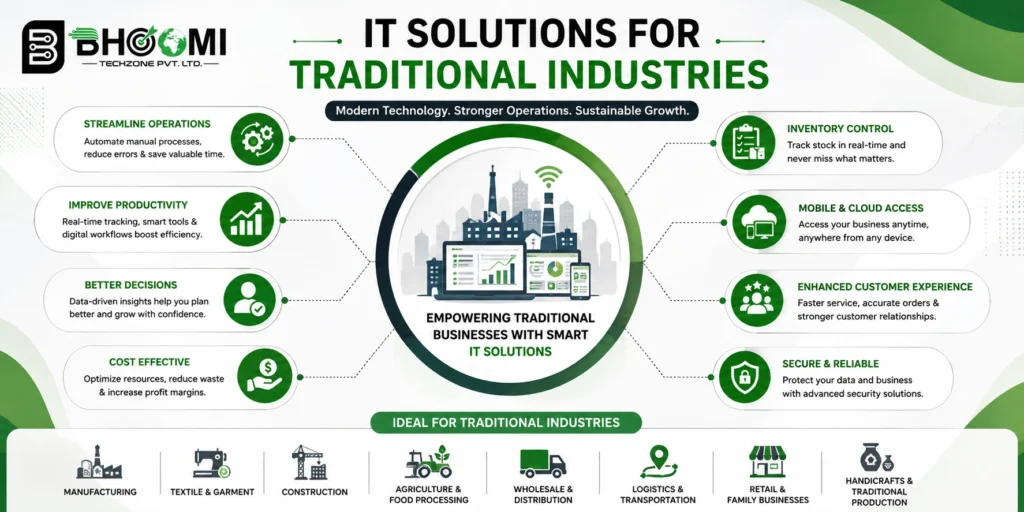
- Tracking raw material and finished goods inventory without manual stock counts
- Recording production output per shift or per machine automatically instead of manually
- Coordinating field teams – delivery staff, site supervisors, sales agents – through mobile apps
- Managing supplier and customer ledgers digitally instead of in physical registers
- Monitoring equipment usage and maintenance schedules to reduce unplanned downtime
- Centralizing order records that currently live across phone calls and paper slips
Essential IT Solutions for Traditional Industries
A handful of tool categories cover most of what businesses actually need when exploring IT solutions for traditional industries:
- Inventory and stock management systems – real-time visibility into raw material and finished goods
- Production tracking tools – recording output, downtime, and machine performance on the shop floor
- Mobile field apps – allowing delivery staff, agents, or site supervisors to log activity remotely
- Cloud-based record keeping – digitizing ledgers, invoices, and supplier records with backup
- Basic ERP or order management systems – connecting purchasing, production, and sales data
- IoT sensors for equipment monitoring – tracking machine health and usage patterns
- Custom software – built for workflows unique to a specific trade or production process
From Paper Records to Digital Operations: A Practical Transition
Moving away from paper doesn’t need to happen overnight, and attempting a full switch immediately often backfires. A more realistic sequence looks like this:
- Identify one specific paper-based process causing the most repeated frustration
- Digitize that single process first – inventory counts, delivery logs, or supplier orders
- Run the digital system alongside the paper process for a trial period
- Train the specific staff involved, with hands-on support rather than a one-time demo
- Once that process is stable, move to the next paper-heavy area
This staged approach tends to work far better than trying to digitize an entire operation at once, since it gives staff time to build confidence with each change before the next one arrives – a principle that applies to nearly every successful rollout of IT solutions for traditional industries.
Industry-Wise Technology Use Cases
Manufacturing: Production tracking tools recording units completed per shift, machine downtime logs, and raw material consumption help identify bottlenecks that were previously invisible in manual reporting.
Textile and Garment Businesses: Inventory systems tracking fabric rolls, work-in-progress at each stitching stage, and finished goods by size and color reduce the guesswork that often leads to overproduction or stockouts.
Construction: Mobile apps letting site supervisors log material deliveries, labor attendance, and progress photos reduce disputes and give project managers real visibility without constant site visits.
Agriculture and Food Processing: Basic tracking tools for harvest quantities, storage conditions, and supply chain movement help reduce spoilage and improve planning around processing schedules.
Wholesale and Distribution: Digital order management replacing phone-and-notebook order taking reduces lost orders and gives a clearer, real-time picture of what’s actually been promised to customers.
Logistics and Transportation: GPS-based tracking and digital delivery confirmations reduce disputes over delivery timing and give better visibility into fleet utilization.
Retail and Family-Run Businesses: Simple point-of-sale and inventory systems replace manual billing books, making it easier to track what’s actually selling versus what’s just sitting on shelves.
Handicrafts and Traditional Production: Basic online catalogs and order tracking help artisan businesses manage custom orders and reach buyers beyond their immediate local market, without changing the actual craft process itself.
Legacy Systems vs Modern IT Infrastructure
| Traditional Process | Digital IT Solution | Business Benefit |
| Manual stock counting on paper registers | Inventory management software with barcode or manual entry | Fewer counting errors and real-time stock visibility |
| Phone-based order taking | Digital order management system | Reduced lost orders and clearer order history |
| Paper delivery challans | Mobile app-based delivery confirmation | Fewer disputes and faster reconciliation |
| Handwritten production logs | Digital production tracking per shift or machine | Easier identification of bottlenecks |
| Ledger-based bookkeeping | Cloud-based accounting or record software | Backup protection and easier historical lookups |
| Manual equipment inspection schedules | IoT-based or app-based maintenance tracking | Better maintenance planning and reduced unplanned downtime |
How Cloud, Mobile Apps, IoT, and Automation Support Traditional Industries
Cloud systems allow records to be backed up and accessed from anywhere, reducing the risk of losing years of business data to a fire, flood, or simple misplaced register. Mobile apps extend digital access to field staff – delivery personnel, site workers, sales agents – who were previously excluded from digital systems built only for office desks. IoT sensors on machinery can flag maintenance needs before a breakdown halts production, which matters more in industries where equipment downtime directly stops revenue. Automation handles repetitive tasks like reorder alerts or basic reporting, freeing staff time for work that actually requires human judgment.
None of these technologies require replacing existing equipment or processes entirely – most integrate as an additional layer that captures information already being generated, just not previously recorded digitally. This additive approach is part of what makes IT solutions for traditional industries practical rather than disruptive.
Cybersecurity Challenges for Traditional Businesses
Traditional businesses adopting digital tools for the first time often underestimate security risks, partly because they’re new to thinking about data protection at all. Common concerns worth addressing include protecting supplier and customer financial information once it moves online, securing mobile apps used by field staff on personal devices, ensuring cloud-stored records are backed up and recoverable, and training staff – many encountering digital tools for the first time – on basic security practices like password hygiene.
A business moving from paper to digital records for the first time is also, often for the first time, exposed to risks like phishing or accidental data loss, which makes basic security guidance a necessary part of any technology rollout, not an optional add-on.
Common Barriers to Technology Adoption and How to Overcome Them
- Staff resistance – address by starting with tools that clearly reduce daily frustration rather than adding new steps
- Unreliable internet at remote sites – address with tools that support offline data entry, syncing when connectivity returns
- Limited digital literacy – address with hands-on, in-person training rather than relying on manuals or videos alone
- Fear of disrupting production during transition – address by running new systems parallel to existing processes initially
- Uncertainty about return on investment – address by starting with a small, measurable pilot before wider rollout
How to Modernize Without Disrupting Existing Operations
The businesses that adopt IT solutions for traditional industries most successfully tend to follow a similar pattern: they pick one high-friction process, test a solution on a small scale – one production line, one delivery route, one department – and expand only once that pilot proves genuinely useful to the people using it daily. Trying to digitize everything simultaneously across an entire operation is where most failed technology projects in these sectors actually go wrong. The businesses that get IT solutions for traditional industries right tend to treat modernization as an ongoing series of small wins, not a single large event.
Custom Software vs Ready-Made Software for Traditional Industries
Ready-made inventory or accounting software is generally cheaper and faster to set up, and works reasonably well for businesses with fairly standard processes. The limitation shows up when a business’s workflow – a specific production sequence, a unique way of tracking custom orders, or an unusual supply chain structure – doesn’t fit neatly into a generic tool’s assumptions.
Custom software becomes worth considering when a business has tried adapting to ready-made tools repeatedly and keeps running into the same workarounds. It costs more upfront and takes longer to build, but it’s designed around the business’s actual process rather than asking the business to change how it operates to fit the software.
Cost Factors and Implementation Considerations
Cost for IT solutions for traditional industries depends on several factors: the number of locations or sites involved, whether staff need training support beyond a basic walkthrough, how much existing data needs to be migrated from paper or old systems, whether the solution needs to work reliably offline, and the level of customization required for industry-specific workflows.
As a broad, carefully qualified guide, simple inventory or point-of-sale tools tend to sit at the lower end of typical costs, while custom production tracking or multi-site systems sit considerably higher – actual pricing for IT solutions for traditional industries should always come from a provider who understands the specific operation, not a generic quote.
How Small and Family-Run Traditional Businesses Can Start
Smaller, family-run operations don’t need to match the technology scale of a large manufacturer. A practical starting point usually looks like picking the single most time-consuming manual task – often inventory counting or order tracking – and digitizing just that, using simple, affordable tools rather than a comprehensive system. Expansion can happen gradually as the business sees clear value from the first change, rather than committing significant budget to a large rollout upfront. This gradual model is generally the most realistic path for smaller businesses adopting IT solutions for traditional industries.
Choosing the Right IT Partner
A provider genuinely suited to traditional industries should be willing to visit the actual operation – factory floor, warehouse, or site – rather than proposing a solution based purely on a phone call. They should ask detailed questions about existing workflows before recommending any tool, be upfront about what a system can and can’t handle given real-world conditions like poor connectivity or dust, and offer ongoing support rather than disappearing after installation. IT Consulting support can help traditional businesses figure out priorities before committing to a specific system, particularly when it’s not yet clear which process would benefit most from digitization.
How AI Can Support Traditional Industries
AI-driven features are beginning to appear in tools built for traditional sectors, though their usefulness is still fairly narrow and practical rather than transformative. Realistic current applications include demand forecasting based on historical sales patterns, predictive maintenance alerts flagging likely equipment issues before failure, image-based quality inspection on production lines, and automated categorization of inventory or orders. These tools generally assist decision-making rather than replacing the experience-based judgment that comes from years of running a business in a specific trade.
Where Bhoomi Techzone Fits In
Bhoomi Techzone works with traditional businesses to build technology solutions around existing operations rather than asking them to restructure how they work. This typically starts with understanding a business’s actual day-to-day processes – production, inventory, field coordination, or record keeping – before recommending a specific tool or system.
Depending on what a business needs, this can involve Software Development for inventory, production tracking, or order management systems built around a specific trade, Mobile App Development for field staff coordination in construction, logistics, or distribution, and Website Development for businesses like handicraft producers wanting to reach buyers beyond their immediate local market.
For businesses needing ongoing technical help after a system is in place, IT Support Services provide continued assistance, while those wanting to grow visibility for products or services can look into Digital Marketing and SEO Services alongside their operational technology investments.
Frequently Asked Questions
What are IT solutions for traditional industries?
Technology tools – inventory systems, production tracking, mobile apps for field staff, and cloud-based record keeping – designed to reduce manual work in industries like manufacturing, textiles, construction, and agriculture, without requiring a complete overhaul of existing processes. IT solutions for traditional industries are generally introduced gradually rather than all at once.
Do traditional businesses really need to digitize their operations?
Not urgently or completely, but businesses experiencing growing pains from manual processes – lost orders, counting errors, disputed deliveries – often find that digitizing even one specific process reduces meaningful friction.
Can a small family-run business afford IT solutions?
Yes. Starting with a single, focused tool addressing the most time-consuming manual task is generally affordable and doesn’t require the scale of investment a large manufacturer might need.
Will digital systems work at a factory or construction site with poor internet?
Many modern tools support offline data entry that syncs once connectivity is restored, making them workable in environments where continuous internet access isn’t guaranteed.
Is custom software necessary, or can ready-made tools work for traditional industries?
Ready-made tools often work fine for standard processes. Custom software becomes more worthwhile when a business’s specific workflow doesn’t fit generic assumptions built into off-the-shelf software.
How long does it take to modernize a traditional business’s operations?
It varies, but a staged approach – digitizing one process at a time – often takes a few weeks per process rather than attempting a full transformation in one large project.
What’s the biggest barrier to technology adoption in traditional industries?
Staff resistance and unfamiliarity with digital tools tend to be more significant barriers than cost, particularly in businesses where manual processes have worked reliably for years.
Can IT solutions help reduce production errors in manufacturing?
Yes, generally. Digital production tracking can surface bottlenecks and errors – like inconsistent output between shifts – that are difficult to spot through manual, handwritten logs alone.
Are cloud-based systems safe for traditional businesses handling sensitive supplier data?
They can be, provided basic security practices like access controls and regular backups are in place, and staff receive at least basic training on data handling.
How does AI actually help traditional industries right now?
Mainly through practical, narrow applications like demand forecasting, predictive maintenance alerts, and automated inventory categorization, rather than broad, transformative changes to how a business operates.
Should a traditional business digitize everything at once?
Generally not recommended. A staged, one-process-at-a-time approach tends to reduce disruption and gives staff time to adjust before the next change is introduced.
How do I choose the right technology partner for a traditional industry business?
Look for a provider willing to understand your actual operation firsthand, realistic about what technology can and can’t solve given real-world conditions, and committed to ongoing support after implementation.
Final Thoughts
IT solutions for traditional industries work best when they’re introduced as a practical addition to existing operations, not a wholesale replacement of processes that have worked for years. The businesses that see the most benefit typically start small – digitizing one clear pain point, proving its value, and expanding gradually rather than attempting a complete transformation overnight.
If you’re weighing where digital tools might genuinely help your operation without disrupting what already works, the Bhoomi Techzone team is happy to talk through your specific situation – no pressure, just a practical conversation grounded in how your business actually runs.
Written by: Bhoomi Techzone Content Team,
Reviewed by: Technology & Digital Solutions Team, Bhoomi Techzone Pvt. Ltd.
Company: Bhoomi Techzone Pvt. Ltd
Phone: +91 81307 87194
Address: A-43, A Block, Sector 63, Noida, Uttar Pradesh 201301
Website: https://bhoomitechzone.com/