
Quick Answer: How Much Does It Cost to Develop an App in Noida?
The cost of developing an app in Noida can range from around ₹2.5 lakh for a basic custom application to ₹18 lakh–₹40 lakh or more for a complex platform. The final price depends on app features, design, Android and iOS requirements, backend development, integrations, security, and ongoing support.
A business owner planning an app usually starts with a simple question: how much money should I set aside to get it built?
The answer is not always straightforward. A basic app that displays services and accepts inquiries is very different from an e-commerce platform with customer accounts, online payments, delivery tracking, and an admin dashboard. Both are mobile applications, but the development effort behind them is not comparable.
This is why how much does it cost to develop an app in Noida depends more on the project requirements than on the number of screens alone. The technology, user experience, backend functionality, and level of customization all influence the final estimate.
If you are planning an app for a startup, retail business, service company, or established organization, understanding these cost factors will help you prepare a realistic budget before approaching a development team.
Table of Contents
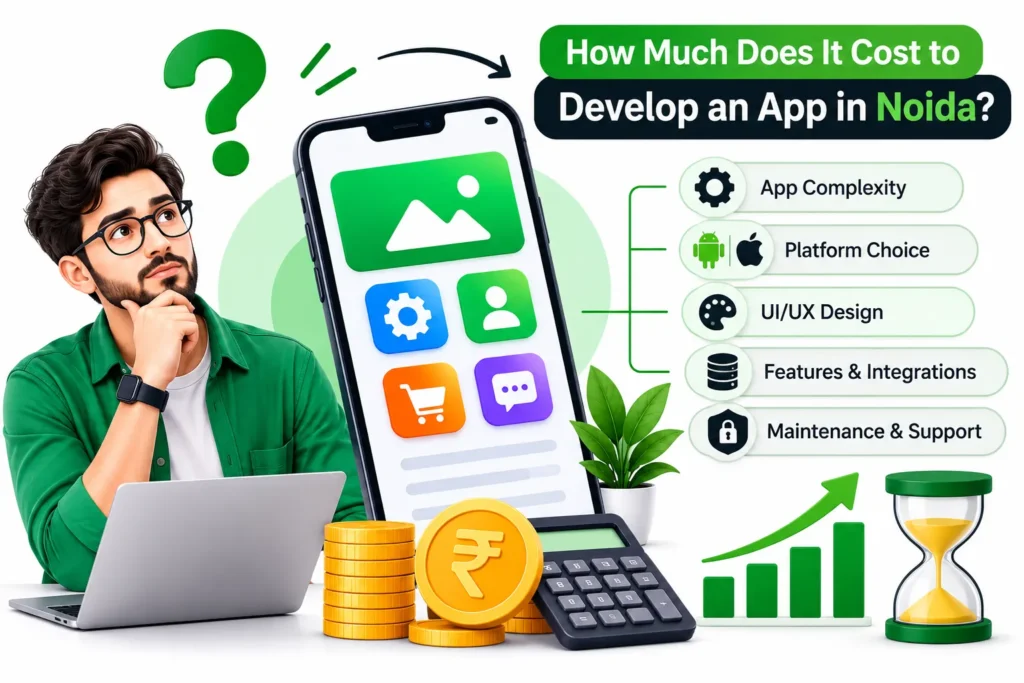
Average App Development Cost in Noida
There is no single price for every mobile application. For planning purposes, custom app development projects can be grouped into three broad complexity levels.
| App Complexity | Indicative Development Cost | Typical Requirements |
| Basic custom app | ₹2.5 lakh–₹6 lakh | Essential screens, basic login, simple forms, and limited backend functionality |
| Medium-complexity app | ₹6 lakh–₹18 lakh | User accounts, payment integration, notifications, admin panel, and database |
| Complex app | ₹18 lakh–₹40 lakh+ | Multiple user roles, real-time features, advanced integrations, and custom backend systems |
| Enterprise application | ₹40 lakh+ | Large-scale workflows, complex permissions, extensive integrations, and advanced security requirements |
These are indicative market estimates for planning, not guaranteed quotations or Bhoomi Techzone’s fixed pricing. A template-based application may cost considerably less than a custom-built product, but the two approaches offer different levels of customization and ownership. The scope of work, team structure, quality requirements, and project timeline also affect pricing.
Before comparing quotations, check whether they include UI/UX design, backend development, testing, deployment, documentation, and post-launch support. A lower headline price may not cover all these activities.
What Factors Affect App Development Cost in Noida?
Two applications in the same industry can have very different budgets. The following factors usually make the biggest difference.
1. App Complexity and Functionality
The more an app needs to do, the more development work it generally requires.
A simple business application might display company information, services, contact details, and enquiry forms. A more advanced application could include customer accounts, order management, online payments, live tracking, and separate dashboards for different users.
Each additional workflow needs to be designed, developed, tested, and maintained. That’s why defining the essential features before development is one of the most useful ways to control costs.
2. Android, iOS, or Both Platforms
Your platform decision affects the development approach and overall budget.
- Android app: Designed for Android smartphones and tablets.
- iOS app: Built for Apple’s iPhone and other supported Apple devices.
- Cross-platform app: Uses a shared codebase to support both Android and iOS.
- Native development: Builds separate applications using platform-specific technologies.
Cross-platform development using technologies such as Flutter or React Native may reduce duplicated development work when compared with two separate native applications. However, it is not automatically the best option for every project. Apps requiring advanced device features, specialized performance, or platform-specific functionality may need a different approach.
3. UI/UX Design Requirements
An app’s design involves more than selecting colours and creating attractive screens.
The team needs to understand how users will move through the application, where important actions should appear, and how information should be presented. This may involve wireframes, prototypes, user flows, custom interface components, and usability testing.
A straightforward interface generally requires less design work than a highly customized application with multiple user journeys and complex dashboards.
4. Backend Development and Database
The backend manages the information and operations that users may not see directly.
For example, when a customer places an order, the backend may need to save the order, update inventory, process payment information, notify the business, and display the latest status.
A simple application may require limited backend functionality. An app with multiple user roles, live updates, reports, and complex business rules needs a more substantial backend system.
5. Third-Party API Integrations
Many applications connect with external services to provide additional functionality.
Common examples include:
- Payment gateway integration
- Google Maps and location services
- SMS and email notifications
- Social login
- Analytics tools
- Shipping and delivery APIs
- Chat and communication services
Integration costs depend on the service, documentation, authentication requirements, testing, and the complexity of data exchange. Some third-party providers also charge separate usage or subscription fees.
6. Admin Panel and User Roles
An admin panel helps the business manage application activity without changing the app’s code for every routine task.
Depending on the project, it may allow administrators to manage users, products, bookings, payments, content, reports, and permissions.
An app with one administrator role is generally simpler than a platform with separate dashboards for customers, vendors, delivery partners, employees, and super administrators.
7. Security and Data Protection
Applications that collect customer details, payment-related information, business records, or sensitive data need appropriate security measures.
These may include secure authentication, role-based access, encrypted communication, protected APIs, backups, and monitoring. The exact requirements depend on the type of application and the information it handles.
Security should be included in the initial project scope rather than treated as an optional task after development.
App Development Cost Based on App Type
The type of application also influences the budget because each category has different workflows and technical requirements.
Cost of Developing an E-commerce App
An e-commerce application may include product listings, search and filters, customer accounts, shopping carts, payment gateways, order tracking, and an admin panel.
The cost increases when the application requires features such as multiple sellers, inventory synchronization, discount rules, loyalty programmes, and delivery integrations.
Cost of Developing a Business App
A business application may help manage enquiries, customers, employees, appointments, documents, or internal workflows.
A basic version with a few essential functions is generally less complex than a customized business management application connected to CRM, ERP, billing, or reporting systems.
Cost of Developing a Food Delivery App
A food delivery platform may need separate interfaces for customers, restaurants, delivery partners, and administrators.
Features such as live order tracking, location services, payment processing, restaurant management, delivery assignment, and notifications add to the development effort.
Cost of Developing a Taxi Booking App
A taxi booking application generally requires passenger and driver interfaces, booking management, GPS tracking, fare calculation, payment options, and trip history.
If the project includes live driver matching, route optimization, multiple vehicle categories, and automated payouts, the backend becomes more complex.
Cost of Developing an Educational App
An educational application may include student accounts, course content, video lessons, assessments, progress tracking, and online payments.
Live classes, interactive learning tools, certificates, and separate teacher and student dashboards can increase the project scope.
Cost of Developing a Healthcare App
A healthcare application may support appointment booking, doctor profiles, patient records, reminders, and consultation management.
Applications handling sensitive health information require careful attention to access controls, privacy, security, and applicable compliance requirements. These requirements should be assessed before estimating the project.
Android vs iOS App Development Cost
Choosing between Android and iOS depends on your target audience, business goals, required functionality, and available budget.
| Development Approach | How It Works | Budget Consideration |
| Android native | Built specifically for Android | Requires Android-focused development and testing |
| iOS native | Built specifically for Apple devices | Requires iOS-focused development and testing |
| Cross-platform | Shared codebase for both platforms | Can reduce duplicated development effort |
| Separate native apps | Two platform-specific codebases | Usually involves more development and maintenance work |
For a startup testing an idea, cross-platform development may be a practical starting point. A product requiring advanced platform-specific functionality may benefit from native development.
The right choice should be made after reviewing the features and expected user experience, not simply by selecting the cheapest option.
How Do App Features Affect Development Cost?
Features influence cost because each one requires development, integration, and testing. Here are some common examples.
| App Feature | What It Does | Cost Impact |
| User registration and login | Allows users to create and access accounts | Depends on authentication requirements |
| User profiles | Stores personal or account information | Depends on profile fields and permissions |
| Push notifications | Sends updates and reminders | Depends on notification rules and setup |
| Payment gateway | Supports online transactions | Depends on payment methods and workflows |
| Real-time tracking | Displays live location or status updates | Can require more backend and API work |
| Chat and messaging | Allows users to communicate | Depends on chat functionality and moderation |
| Admin dashboard | Helps manage app activity | Depends on the number of controls and reports |
| Analytics and reports | Displays business and user activity | Depends on data collection and reporting needs |
A useful approach is to divide features into three groups:
- Must-have: Essential features without which the app cannot perform its main purpose.
- Should-have: Useful features that improve the experience but may not be necessary for the first release.
- Future features: Enhancements that can be introduced after the app has been tested with real users.
This prioritization helps prevent unnecessary development work during the first version.
How Much Does UI/UX Design Cost for an App?
UI/UX design is an important part of app development because it determines how users interact with the product.
The design process may include:
- Understanding the business requirements and target audience.
- Creating user flows and wireframes.
- Designing the visual interface.
- Preparing an interactive prototype.
- Reviewing the design and making improvements.
The cost depends on the number of screens, design complexity, number of user types, custom illustrations, and prototype requirements.
A simple utility app may need a relatively straightforward interface. A marketplace or enterprise application with multiple dashboards requires more detailed design planning.
It is worth finalizing the main user journeys before development begins. Major design changes during coding can lead to additional work and project delays.
Additional Costs to Consider After App Development
The development quotation is not always the full cost of owning an application. Some expenses continue after launch.
| Additional Expense | Why It May Be Required |
| Hosting and cloud services | To run the backend and store application data |
| App maintenance | To fix issues and keep the app working properly |
| Security updates | To address vulnerabilities and improve protection |
| Third-party services | For maps, SMS, email, payments, or other integrations |
| App store accounts | For publishing and managing applications |
| Feature upgrades | To add functionality as business requirements change |
| Technical support | To investigate and resolve post-launch issues |
Maintenance costs depend on the application, hosting setup, support agreement, and frequency of updates. Ask the development company to explain what is included in its maintenance plan and which services will be billed separately.
Also confirm who owns the source code, hosting account, domain-related assets, app store accounts, and third-party subscriptions.
How Long Does It Take to Develop an App?
Development time depends on the number of features, design requirements, integrations, testing, and approval process.
| App Complexity | Indicative Timeline |
| Basic app | 6–10 weeks |
| Medium-complexity app | 10–16 weeks |
| Complex application | 4–6 months or longer |
| Enterprise platform | Depends on project scope and phased delivery |
These are broad planning estimates, not guaranteed delivery dates. Delays may occur if requirements change, content or approvals are late, third-party integrations take longer than expected, or testing identifies issues that need correction.
A written project plan with milestones makes it easier to track progress and manage expectations.
Custom App Development vs Ready-Made Solutions: Which Is More Cost-Effective?
Not every business needs a completely custom application. The right approach depends on how closely existing solutions match your requirements.
| Comparison | Ready-Made Solution | Custom App Development |
| Initial investment | Usually lower | Usually higher |
| Development time | Often shorter | Depends on project scope |
| Customization | Limited by the platform | Built around specific requirements |
| Ownership and control | Depends on provider terms | Can provide greater control under the agreed contract |
| Scalability | Depends on available plans and features | Can be planned around future needs |
| Best suited for | Standard business requirements | Specific workflows or unique product ideas |
A ready-made solution may work well when your business needs standard booking, ordering, or catalogue functionality. Custom development is worth considering when existing products cannot support your workflows or when the application itself is a core business product.
Before choosing either option, compare the total cost over time, including subscriptions, customization, integrations, maintenance, and data access.
How to Estimate Your App Development Budget
Before requesting a quotation, prepare a short project brief. It does not need to be a technical document. It simply needs to explain what you want the app to do.
Use this checklist:
- Define the purpose: Explain the main problem the app should solve.
- Identify the users: Decide whether the app is for customers, employees, vendors, or multiple user groups.
- List essential features: Separate must-have features from future enhancements.
- Select the platforms: Decide whether you need Android, iOS, or both.
- Plan the design: Identify whether you need a standard interface or a fully customized user experience.
- Identify integrations: List payment gateways, maps, notifications, and other external services.
- Plan the admin panel: Decide what information and activities your team needs to manage.
- Include ongoing expenses: Account for hosting, maintenance, third-party services, and support.
- Set project milestones: Agree on design approval, development stages, testing, and launch.
Once these details are clear, a development team can prepare a more meaningful estimate. This is much more useful than asking for a price based only on an app idea.
How to Choose the Right App Development Company in Noida
Price matters, but it should not be the only factor when selecting a development partner.
Before making a decision, review the company’s relevant project experience, development process, communication practices, testing approach, and post-launch support. Ask for a written proposal that explains the features, deliverables, timeline, payment milestones, and exclusions.
It is also important to clarify source-code ownership, access to project accounts, documentation, and maintenance responsibilities before signing an agreement.
If you are comparing development partners, read our detailed guide to choosing a mobile app development company in Noida for more information about evaluating services and development teams.
Frequently Asked Questions
1. How much does it cost to develop an app in Noida?
A basic custom app may cost around ₹2.5 lakh–₹6 lakh, a medium-complexity application around ₹6 lakh–₹18 lakh, and a complex platform ₹18 lakh–₹40 lakh or more. These are indicative estimates; the actual quotation depends on features, platforms, integrations, design, and project requirements.
2. What is the minimum cost to develop a mobile app?
A simple template-based app may cost considerably less than a custom application. A basic custom app generally requires a larger budget because it involves design, development, testing, and backend work. The minimum investment depends on what the application needs to do.
3. How much does it cost to develop an Android app?
The cost depends on the app’s complexity, number of screens, backend requirements, and features. A basic Android app will generally require less development effort than an application with payments, live tracking, multiple user roles, and a custom admin panel.
4. Is iOS app development more expensive than Android?
Neither platform is automatically more expensive in every project. The final cost depends on design, device-specific functionality, integrations, testing requirements, and the development approach.
5. How much does it cost to develop an e-commerce app?
An e-commerce app’s budget depends on product management, customer accounts, shopping cart, payments, order tracking, inventory, and admin functionality. A single-store app is generally less complex than a multi-vendor marketplace.
6. How long does it take to develop a mobile app?
A basic app may take around 6–10 weeks, while a medium-complexity project may take 10–16 weeks. Complex applications can take several months or longer, depending on features, integrations, testing, and approvals.
7. Does app maintenance require an additional budget?
Yes. Maintenance may include bug fixes, compatibility updates, security improvements, server monitoring, and technical support. Check whether these services are included in the original quotation or covered by a separate agreement.
8. Can I develop an app with a limited budget?
Yes. Start by identifying the one main problem the app needs to solve. Build the essential features first and consider adding advanced functionality after receiving feedback from users. This approach helps control the initial investment.
9. What makes custom app development expensive?
Complex backend systems, multiple user roles, real-time functionality, custom UI/UX, third-party integrations, security requirements, and extensive testing can increase development effort and cost.
10. Is cross-platform app development more affordable?
It can be, because developers may use a shared codebase for Android and iOS instead of building two separate native applications. However, the final cost depends on the required functionality and whether platform-specific development is needed.
Final Thoughts
Understanding app development costs before starting a project helps you make better decisions about features, technology, timelines, and long-term expenses.
The most practical way to approach how much does it cost to develop an app in Noida is to begin with the business requirement rather than a fixed budget figure. A simple application may need only a few essential features, while a larger platform may require multiple interfaces, integrations, and a custom backend.
Start with the functionality your users genuinely need. Compare proposals based on their scope and deliverables, and make sure the quotation covers testing, deployment, ownership, and ongoing support.
At Bhoomi Techzone, we help businesses evaluate their application requirements and plan custom mobile app development around their goals. If you have an app idea, discuss your requirements with our team to understand the possible development approach, timeline, and budget.
Written by: Gausiya Jarrin, Senior SEO Specialist
Reviewed by: Aman diwedi, CEO
Company: Bhoomi Techzone Pvt. Ltd.
Phone: +91 81307 87194
Address: A-43, A Block, Sector 63, Noida, Uttar Pradesh 201301
Website: https://bhoomitechzone.com/