Phone: +91 81307 87194
Quick Answer:
Custom software development services involve designing and building software specifically around a business’s processes, users, and requirements. Unlike ready-made software, custom solutions can be tailored to specific workflows, integrations, security needs, and future growth. They can include CRM, ERP, dashboards, automation platforms, customer portals, and other business applications.
Businesses often reach a point where spreadsheets, disconnected tools, or generic software no longer fit the way their teams actually work. One department may use one system, and another may maintain separate spreadsheets, while important information is still exchanged manually through email or messaging apps.
That is where custom software can become useful.
Instead of changing the business process to fit an existing application, a custom solution is designed around the actual process. However, building custom software is a significant investment, so it is important to understand when it makes sense, what development involves, how much it may cost, and what to look for in a development partner.
Table of Contents
What Are Custom Software Development Services?
Custom software development services are professional services used to plan, design, develop, test, deploy, and maintain software created for a specific business or organization.
The software may be a web-based business platform, mobile application, internal management system, customer portal, CRM, ERP, inventory platform, booking system, or workflow automation solution.
The key difference is customization. Instead of buying a product with a fixed set of features, the business defines what the software needs to accomplish, and the development team builds the required functionality around those needs.
For example, a distributor may need inventory management, purchase tracking, sales reporting, employee access controls, and integration with an existing accounting system. Rather than using several disconnected applications, a custom business software solution can bring these workflows into one platform.
Why Do Businesses Choose Custom Software?
The main reason businesses choose custom software is usually not technology itself. It is a business problem that existing software does not solve efficiently.
A company may consider custom development when:
- Existing software has too many unnecessary features.
- Important business processes cannot be automated.
- Multiple systems do not communicate with each other.
- Employees rely heavily on spreadsheets or manual data entry.
- The business needs a specialized customer or employee portal.
- Existing software cannot scale with growing operations.
- Industry-specific workflows require greater flexibility.
- The company needs greater control over its data and functionality.
Custom development can also be useful when software becomes a strategic part of how a business operates rather than simply another productivity tool.
Custom Software vs. Off-the-Shelf Software
Choosing between custom and ready-made software depends on the business’s requirements, budget, timeline, and expected growth.
| Factor | Custom Software | Off-the-Shelf Software |
| Customization | Built around specific requirements | Limited to available features |
| Scalability | Can be developed around future needs | Depends on vendor capabilities |
| Initial cost | Usually higher | Usually lower |
| Development time | Requires planning and development | Can often be used quickly |
| Integrations | Can be designed for specific systems | Depends on available integrations |
| Ownership and control | Greater control over the solution | Controlled largely by software vendor |
| Best suited for | Specialized or complex requirements | Standard business requirements |
There is no universal winner.
If a business needs accounting software for common accounting tasks, buying an established product may be more practical. If the business has a unique workflow that existing applications cannot handle efficiently, custom development may offer a better long-term fit.
What Is Included in Custom Software Development Services?
A professional development project normally involves much more than writing code.
Depending on the project, the scope may include:
Requirement Analysis
The development team first needs to understand the business problem, users, workflows, and expected outcome.
This stage can involve stakeholder discussions, process mapping, feature prioritization, technical assessment, and documentation.
UI/UX Design
The interface is planned around the people who will actually use the software.
This can include:
- User flows
- Wireframes
- Interface design
- Responsive layouts
- Navigation structure
- Prototypes
- Usability considerations
Good design is not simply about making software look attractive. It should make important tasks easier to understand and complete.
Software Development
Developers then build the required functionality using appropriate programming languages, frameworks, databases, APIs, and infrastructure.
The technology stack should be selected according to project requirements rather than because a particular technology is currently popular.
Testing and Quality Assurance
Testing helps identify functional, compatibility, performance, security, and usability problems before the software reaches users.
Depending on the project, testing may include:
- Functional testing
- Integration testing
- Performance testing
- Security testing
- User acceptance testing
- Cross-device or browser testing
Deployment
Once the application has been tested and approved, it can be deployed to the appropriate environment.
For cloud-based applications, this may involve configuring servers, databases, domains, security controls, monitoring, and deployment pipelines.
Maintenance and Support
Software does not remain unchanged after launch.
Operating environments evolve, dependencies are updated, security issues are discovered, and business requirements change. Ongoing software maintenance can therefore include bug fixing, security updates, performance improvements, compatibility work, and new features.
What Types of Custom Software Can Be Developed?
Custom software can take many forms depending on the business problem.
CRM Software
Custom CRM development can help businesses manage leads, customer information, sales activities, communication, follow-ups, and reporting according to their own sales process.
ERP Software
ERP solutions can connect areas such as finance, inventory, purchasing, human resources, operations, and reporting within a centralized system.
Inventory Management Software
Businesses dealing with products may need software for stock tracking, purchase orders, warehouses, product movement, alerts, and inventory reporting.
Workflow Automation Software
Repeated manual tasks can sometimes be automated through custom workflows.
For example, a process might automatically assign a task to an employee, notify a manager, update a record, and generate a report when a particular condition is met.
Customer Portals
A customer portal can provide users with access to orders, invoices, documents, appointments, support requests, account information, or other services.
Employee Management Systems
Internal applications can help manage attendance, employee information, tasks, leave requests, approvals, performance records, or organizational workflows.
Business Dashboards
Custom dashboards can combine information from different sources and display business metrics in a format that is relevant to management and operational teams.
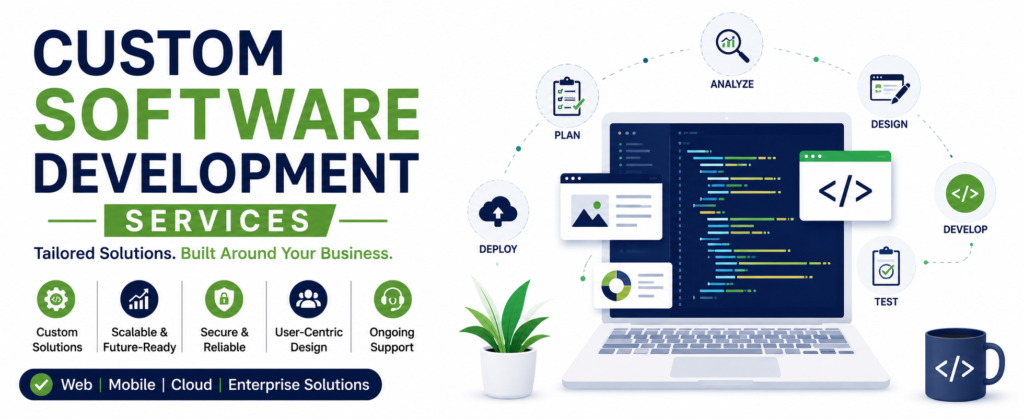
What Is the Custom Software Development Process?
A structured development process reduces uncertainty and makes it easier to identify problems before they become expensive.
A typical process includes the following stages:
1. Discovery and requirement gathering
The team identifies the business problem, target users, workflows, required features, and technical constraints.
2. Planning
The project scope, technology approach, milestones, resources, and priorities are defined.
3. UI/UX design
User journeys and interfaces are designed before development moves too far ahead.
4. Development
The software is developed in planned stages. Depending on the project, teams may use an agile approach with regular iterations and feedback.
5. Testing
The application is tested against functional and technical requirements.
6. Deployment
The approved version is moved into the production environment.
7. Monitoring and maintenance
After launch, performance, security, errors, and user feedback are monitored so issues can be addressed as they appear.
The exact process can vary according to project size and methodology, but skipping requirement analysis or testing often creates avoidable problems later.
Which Technologies Are Used?
There is no single technology stack that is right for every project.
A custom software development company may use different technologies depending on requirements, existing infrastructure, performance expectations, security needs, and team expertise.
Common technology categories include
- Frontend: React, Angular, Vue, HTML, CSS, JavaScript
- Backend: Node.js, PHP, Python, Java, .NET
- Databases: MySQL, PostgreSQL, MongoDB, and other database systems
- Cloud: AWS, Microsoft Azure, Google Cloud
- APIs: REST APIs and other integration approaches
- Mobile: Native Android/iOS technologies or cross-platform frameworks
- DevOps: CI/CD pipelines, containers, monitoring, and cloud deployment tools
The important question is not simply whether a provider uses a particular framework. The better question is whether the chosen architecture is appropriate for the software’s current and future requirements.
What Are the Benefits of Custom Software?
The biggest advantage is control over how the software works.
Depending on the project, businesses may benefit from:
Better Process Alignment
The application can reflect the company’s actual workflow rather than forcing employees to work around software limitations.
Greater Flexibility
Features can be designed around specific operational requirements.
Easier Integration
Custom applications can be developed to communicate with existing systems through APIs and other integration methods.
Scalability
The architecture can be planned around expected business growth, although scalability still depends on good technical decisions and ongoing infrastructure management.
Improved Automation
Manual processes can potentially be converted into automated workflows, reducing repetitive administrative work.
Better Data Visibility
Information from multiple business processes can be brought together into dashboards and centralized systems.
Long-Term Control
Businesses can have greater control over features, integrations, workflows, and future development compared with products controlled entirely by a third-party software vendor.
What Are the Challenges and Limitations?
Custom software is not automatically the right choice for every business.
There are important considerations.
Higher initial investment: Building software specifically for one organization generally requires more upfront work than subscribing to an existing application.
Longer implementation: Requirements, design, development, testing, and deployment take time.
Ongoing responsibility: Software needs maintenance after launch.
Requirement changes: Poorly defined requirements can lead to scope changes, delays, or additional development costs.
Technical dependency: Businesses need access to capable developers or a reliable technology partner for future updates.
This is why a proper discovery process is important before development begins.
How Much Does Custom Software Development Cost in India?
The cost of custom software development services in India varies significantly because projects can range from relatively simple internal applications to large enterprise platforms.
The main cost factors include:
- Number of features
- Software complexity
- Number of users
- UI/UX requirements
- Web, mobile, or both
- Third-party integrations
- API development
- Database architecture
- Admin dashboards
- Security requirements
- Cloud infrastructure
- Testing requirements
- Maintenance and support
For example, a simple internal workflow application and a multi-user enterprise ERP system should not be expected to have the same development cost.
A reliable estimate should therefore come after understanding the requirements rather than being based on the project title alone.
How Long Does Custom Software Development Take?
There is no universal timeline.
A relatively small application with limited functionality may take weeks or a few months, while a complex business platform involving multiple user roles, integrations, dashboards, mobile applications, and extensive testing can take considerably longer.
The timeline is usually influenced by:
- Project complexity
- Number of features
- Design requirements
- Integration requirements
- Number of platforms
- Feedback and approval cycles
- Testing requirements
- Changes in scope
A realistic development timeline should be created after requirements are understood.
Is Custom Software Suitable for Small Businesses?
Yes, but size alone should not determine the decision.
A small business may benefit from custom software when it has a specific operational problem that existing tools cannot handle efficiently.
For example, a growing service business may need a system combining customer inquiries, scheduling, employee assignments, invoices, and reporting. If several disconnected tools are creating unnecessary manual work, a focused custom application may be worth considering.
On the other hand, if an affordable off-the-shelf application already solves the business’s requirements, custom development may add unnecessary complexity and cost.
The right question is therefore not “Is my business large enough?” but “Is there a business problem significant enough to justify building a specialized solution?”
Custom Software Development Services for Different Industries
Different industries often have different workflows, which is one reason businesses may seek specialized software.
Healthcare
Potential applications include appointment management, patient portals, internal workflows, scheduling, and administrative systems.
Real Estate
Custom platforms can support property listings, lead management, agent workflows, customer communication, and reporting.
E-commerce
Businesses may need inventory systems, order management, customer portals, vendor management, or integrations with external services.
Education
Software may support student management, course administration, scheduling, assessments, communication, and reporting.
Logistics
Custom solutions can manage shipments, vehicle information, tracking workflows, delivery assignments, and operational reporting.
The exact requirements should always be determined by the organization’s actual workflow rather than simply copying features from another industry.
Custom Software Development Company in Noida: What Should You Check?
Businesses searching for a custom software development company in Noida should evaluate providers based on their actual capabilities rather than location alone.
Before choosing a provider, consider:
- Experience with projects similar to yours
- Technical expertise relevant to your requirements
- Clarity of the development process
- Quality assurance and testing practices
- Security approach
- Communication and reporting
- Post-launch support
- Ownership and source-code terms
- Documentation
- Pricing transparency
For businesses in Delhi NCR, local proximity can make meetings and communication easier, but the quality of the technical process remains more important than simply having an office nearby.
How to Choose a Custom Software Development Services Company
Choosing a development partner is an important decision because the relationship may continue well beyond the initial launch.
Ask potential providers:
Can you explain the proposed architecture?
A capable team should be able to explain the technical approach in language that business stakeholders can understand.
How do you handle changing requirements?
Changes happen. The important thing is having a clear process for evaluating their effect on scope, cost, and timeline.
How is testing handled?
Ask what types of testing are included and when testing takes place.
Who owns the software?
Clarify source-code ownership, licenses, documentation, hosting access, and intellectual property terms before signing.
What happens after launch?
Understand maintenance, bug fixes, monitoring, updates, and support arrangements.
How will progress be communicated?
Regular demonstrations, project updates, documentation, or milestone reviews can make development more transparent.
Common Mistakes Businesses Should Avoid
Several mistakes can make a software project unnecessarily difficult.
Starting Development Without Clear Requirements
If the business problem is not clearly defined, developers may build features that do not solve the real problem.
Focusing Only on Price
The cheapest proposal may not include the same functionality, testing, security, documentation, or support as another proposal.
Adding Every Feature at Once
A large feature list can increase complexity before the core product is validated.
A better approach may be to prioritize the essential functionality first.
Ignoring Security
Security should be considered during architecture and development, not added only after the software is complete.
Forgetting Maintenance
The project does not necessarily end at deployment. Software requires updates and support as its environment changes.
Not Defining Ownership
Source-code access, hosting accounts, documentation, licenses, and intellectual property should be clearly addressed in the agreement.
Custom Software Development Services in India
India has become an important technology development market because businesses can access software development teams with experience across web, mobile, cloud, enterprise applications, and business automation.
For an Indian business, working with a local or India-based development provider can also simplify communication around local business requirements, payment systems, regional workflows, and support arrangements.
However, geography should not be the only selection criterion. Technical capability, communication, development methodology, security, documentation, and long-term support should also be evaluated.
Custom Software Development Services and AI Search
Businesses researching technology providers increasingly ask specific questions through Google, AI-powered search, and conversational tools instead of relying only on traditional keyword searches.
Someone may search:
- “How much does custom software development cost in India?”
- “Is custom software better than SaaS?”
- “Can custom software integrate with an existing CRM?”
- “How long does a custom business application take?”
- “What should I ask a software development company?”
This makes clear and well-structured information increasingly useful.
For AI search systems to understand a topic accurately, the content needs clear definitions, contextual relationships, direct answers, and supporting explanations. Structured information can make it easier for search systems to understand what a company offers and what questions its content addresses.
However, strong content does not guarantee Google AI Overview visibility, rankings, or AI citations. Search systems make those decisions independently.
For businesses, the practical priority should remain the same: provide accurate information that genuinely answers customer questions.
Where Bhoomi Techzone Fits Into This
Bhoomi Techzone provides technology services for businesses that need websites, applications, software solutions, and related technical support.
For businesses considering custom software development services, the starting point should be the business requirement rather than a predefined technology stack. Understanding the existing workflow, users, integrations, challenges, and future requirements helps determine whether custom development is actually appropriate.
Depending on the project, the work may involve business application development, workflow automation, dashboards, integrations, customer-facing platforms, or internal management systems.
Bhoomi Techzone can also support related technology requirements such as Website Development, Mobile App Development, IT Support Services, Website Maintenance, SEO Services, and Digital Marketing Services.
The appropriate solution depends on the project’s scope, technical requirements, budget, and long-term objectives. A responsible development approach should identify those factors before committing to a particular solution.
Frequently Asked Questions
What are custom software development services?
Custom software development services involve planning, designing, developing, testing, deploying, and maintaining software specifically for a business or organization. The solution is built around the client’s workflows, users, features, integrations, and technical requirements rather than using a fixed product.
What does custom software development services include?
It can include requirement analysis, UI/UX design, software development, database development, API integration, testing, deployment, cloud configuration, security implementation, documentation, and ongoing maintenance. The exact scope depends on the software being developed.
Why choose custom software instead of off-the-shelf software?
Custom software can be useful when existing applications cannot efficiently support a business’s specific workflows, integrations, or scalability requirements. Off-the-shelf software can still be a better option when standard features already meet the business’s needs.
How much does custom software development cost in India?
There is no single price because development cost depends on complexity, features, platforms, integrations, users, security requirements, design, infrastructure, testing, and support. A reliable estimate normally requires reviewing the project’s requirements first.
How long does custom software development take?
The timeline depends on project complexity, feature count, platforms, integrations, testing, and feedback cycles. A small application may take weeks or months, while a larger enterprise platform can require considerably more development time.
Is custom software suitable for small businesses?
Yes, when the business has a specific problem that existing software cannot solve efficiently. Small businesses should still compare the cost and complexity of custom development against available off-the-shelf solutions before making a decision.
What types of businesses need custom software?
Businesses in healthcare, real estate, education, logistics, e-commerce, finance, manufacturing, professional services, and other sectors may use custom applications when they have specialized workflows, integration requirements, or automation needs.
Can custom software integrate with existing systems?
Yes. Custom applications can often integrate with existing CRM, ERP, payment, accounting, inventory, communication, analytics, or other systems through APIs and other integration methods. The feasibility depends on the systems involved and their available integration capabilities.
What technologies are used for custom software development?
The technology depends on the project. Development teams may use technologies such as React, Angular, Vue, Node.js, Python, PHP, Java, .NET, MySQL, PostgreSQL, MongoDB, AWS, Azure, and Google Cloud, among others.
Does custom software include maintenance and support?
It can, although maintenance is often handled through a separate agreement or ongoing service plan. Support may include bug fixes, security updates, performance improvements, compatibility updates, monitoring, and future feature development.
How do I choose a custom software development company?
Look at relevant technical experience, development methodology, communication, testing practices, security, documentation, ownership terms, pricing clarity, and post-launch support. Ask specific questions instead of relying only on portfolio screenshots or marketing claims.
What is the biggest advantage of custom software?
The primary advantage is flexibility. A custom solution can be designed around the organization’s actual workflows and requirements, potentially reducing the need to work around limitations found in generic software.
Final Thoughts
Custom software development services can be a practical option when a business has workflows, integration requirements, or operational challenges that existing software cannot address effectively.
But custom development is not automatically better than ready-made software. The right choice depends on the problem being solved, the expected return on the investment, the complexity of the requirements, and the organization’s ability to maintain the software over time.
Before selecting a provider, compare more than price. Look at the development process, technical approach, testing, security, ownership, communication, and post-launch support.
If you’re considering a custom software project for your business, Bhoomi Techzone can help you evaluate the requirement and determine what type of solution may be appropriate before development begins.
Written by: Bhoomi Techzone Content Team
Reviewed by: Senior SEO & Digital Marketing Consultant
Company: Bhoomi Techzone Pvt. Ltd.
Phone: +91 81307 87194
Address: A-43, A Block, Sector 63, Noida, Uttar Pradesh 201301
Website: https://bhoomitechzone.com/