Phone: +91 81307 87194
Quick Answer
Digital solutions for traditional businesses typically include websites, mobile apps, CRM and ERP systems, digital payments, inventory management, and workflow automation. The right starting point depends on the business’s biggest manual bottleneck, not on adopting every available tool at once.
Most traditional businesses don’t wake up one day deciding to “go digital”. It usually starts smaller than that – a shopkeeper tired of tracking inventory on paper, a distributor drowning in WhatsApp orders that get lost between chats, a clinic that keeps double-booking patients because appointments are scheduled over the phone. Digital solutions for traditional businesses exist to fix these specific, everyday frustrations, not to force a business into some abstract “digital-first” identity.
This article is written for business owners who aren’t particularly technical and just want a clear, practical understanding of what’s actually available, what it costs, and where a reasonable starting point looks like for a business that’s been running the same way for years.
Table of Contents
What Are Digital Solutions for Traditional Businesses?
Digital solutions for traditional businesses refer to technology tools – websites, apps, software, automation systems – that help a business run more efficiently, reach more customers, or manage information better than manual, paper–based, or purely offline methods allow.
This doesn’t mean replacing everything a business already does. Many traditional businesses run on genuinely sound processes; digital tools typically just remove the friction, repetition, and error–proneness of doing those same processes manually – which is really the practical value that digital solutions for traditional businesses are meant to add.
Why Traditional Businesses Need Digital Solutions Today
A few practical shifts are pushing traditional businesses toward digital tools, whether they were planning for it or not:
- Customers increasingly expect to find a business online before visiting or calling
- Manual record–keeping becomes harder to manage as a business grows
- Competitors adopting digital tools can offer faster service or better convenience
- Younger customers often prefer digital payments, online booking, or app–based ordering
- Manual processes tend to produce more errors as transaction volume increases
None of this means digital transformation is urgent for every business overnight. But the businesses that wait too long often find themselves reacting to a problem rather than getting ahead of it – which is part of why exploring digital solutions for traditional businesses early, even in a small way, tends to pay off.
Common Problems Digital Solutions Can Solve
A lot of traditional businesses share similar pain points, even across very different industries:
- Orders or inquiries getting lost across phone calls, WhatsApp, and walk–ins
- No centralized way to track inventory or stock levels
- Manual bookkeeping that makes it hard to see real–time business performance
- Customer information scattered across notebooks, spreadsheets, and memory
- No online presence, making the business hard to find or compare against competitors
Digital solutions for traditional businesses generally target one or more of these specific problems, rather than being a vague, all–purpose upgrade.
Types of Digital Solutions for Traditional Businesses
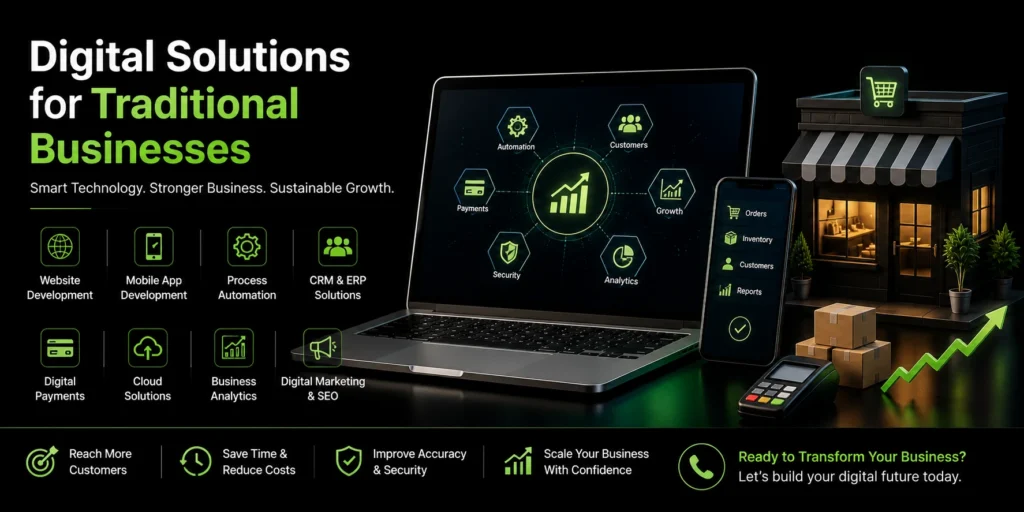
Depending on the specific need, digital tools generally fall into a few categories:
- Business websites – establishing an online presence and basic credibility
- E–commerce platforms – selling products directly online
- Mobile applications – for businesses needing app–based ordering, booking, or service delivery
- CRM systems – organizing customer information and interactions in one place
- ERP software – coordinating operations across departments for larger businesses
- Custom software – solving a specific operational problem generic tools don’t cover
- Workflow automation – reducing repetitive manual tasks
- Cloud solutions – accessible data and systems from anywhere, not tied to one physical location
- Digital payment systems – accepting payments beyond cash
- Online booking systems – reducing scheduling conflicts and phone–based booking
- Inventory management systems – real–time stock tracking
- Customer portals – allowing customers to self–serve certain requests
- Business dashboards – visualizing performance data instead of digging through records
- Digital marketing and SEO – helping the business actually get found online
Not every business needs all of these – usually just the two or three digital solutions for traditional businesses that address its most pressing operational gap.
Digital Solutions for Different Types of Traditional Businesses
Retail: A retailer may begin with a website, online catalogue, digital payments, and basic inventory management to replace manual stock counts.
Manufacturing: A manufacturer may need ERP integration, production tracking, and internal dashboards to coordinate across departments more effectively.
Healthcare: A clinic may benefit from an online booking system and patient record management to reduce scheduling conflicts and paperwork.
Education: An institute may use a website, online enrollment forms, and communication tools to reduce manual admin work.
Real Estate: A real estate business may need a property listing website with search and inquiry forms to manage leads more systematically.
Restaurants: A restaurant may benefit from online ordering, digital payments, and a simple reservation system.
Logistics: A logistics business may need order tracking, route management, and customer notification systems.
Local Service Businesses: A local service business may first benefit from a professional website and online booking system before investing in a full mobile app.
Distributors: A distributor managing orders through WhatsApp and spreadsheets may eventually need a centralized order management system to reduce lost or duplicated orders.
How to Start Digital Transformation in a Traditional Business
Digital transformation doesn’t need to happen all at once. A reasonable, gradual process looks like this:
- Identify manual processes – figure out where time and accuracy are actually being lost
- Understand customer needs – what would actually make the customer experience better
- Choose the right digital priorities – focus on the highest–impact problem first
- Start with essential tools – a website, basic CRM, or simple automation
- Integrate systems – connect tools so data doesn’t need to be re–entered manually
- Train employees – even the best tool fails if the team doesn’t know how to use it
- Measure and improve – review what’s working and adjust before adding more tools
Skipping straight to step four without steps one and two is one of the more common reasons digital projects don’t deliver the expected value – the same mistake shows up again and again when traditional businesses adopt digital solutions without first understanding the actual problem.
Website vs Mobile App vs Custom Software
These three often get lumped together, but they serve different purposes and fit different situations.
| Factor | Website | Mobile App | Custom Software |
| Primary Purpose | Online presence, information, basic transactions | Ongoing engagement, app–based service delivery | Solving specific internal or operational problems |
| Typical Users | General public, potential customers | Repeat customers, frequent users | Internal staff, specific business processes |
| Development Complexity | Lower to moderate | Moderate to high | Moderate to high, depending on scope |
| Initial Investment | Generally lower | Moderate to higher | Varies widely based on requirements |
| Development Timeline | Weeks | A few months | A few months to longer, depending on complexity |
| Scalability | Good for content and basic transactions | Good for engagement–heavy use cases | Built specifically to scale with business needs |
| Best Suited For | Most businesses needing basic online presence | Businesses with frequent, repeat customer interaction | Businesses with specific workflows generic tools can’t handle. |
Many traditional businesses start with a website, since it typically has the lowest barrier to entry, and consider a mobile app or custom software later as specific needs become clearer – a fairly typical progression among digital solutions for traditional businesses.
Benefits of Digital Solutions for Traditional Businesses
When implemented thoughtfully, digital tools typically offer:
- Improved efficiency through reduced manual, repetitive work
- Better customer experience with faster response times and self–service options
- Improved data management, replacing scattered records with centralized systems
- Easier communication between teams, departments, and customers
- Better reporting, making business performance visible in real time
- Scalability that supports growth without proportionally increasing manual workload
- Wider market reach beyond a business’s immediate physical location
These benefits typically compound over time rather than showing up immediately after implementation, which is one reason patience matters when evaluating digital solutions for traditional businesses.
Challenges and Limitations
It’s worth being honest about the trade–offs involved, since digital transformation isn’t automatically smooth or immediately beneficial:
- Initial investment can be significant, depending on the solution chosen
- Employee resistance to new tools and changed workflows is common
- Training requirements take time and effort that businesses sometimes underestimate
- Data security becomes a real consideration once information moves online
- Choosing the wrong technology for the actual problem wastes both time and money
- Poor implementation planning often causes more disruption than the manual process it replaced
- Ongoing maintenance is necessary – digital tools aren’t a one–time setup
None of these challenges are reasons to avoid digital solutions for traditional businesses altogether – they’re reasons to plan implementation carefully rather than rushing into the first available tool.
How Much Do Digital Solutions Cost?
There’s no single universal price, since cost depends heavily on several factors:
- Type of solution – a basic website costs far less than custom enterprise software
- Business size and number of users the system needs to support
- Number of features and level of customisation required
- Whether the solution is a website, app, or custom software
- Integrations needed with existing tools or third–party systems
- UI/UX design requirements
- Cloud infrastructure and hosting needs
- Security requirements, particularly for payment or customer data handling
- Ongoing maintenance and support costs after launch
As a general industry–level reference, simple websites or basic automation tools tend to sit at the lower end of typical technology spending, while custom software or full ERP integrations sit considerably higher – though any specific number for digital solutions for traditional businesses should come from a provider reviewing the business’s actual requirements, not a generic price list.
Digital Solutions for Small and Medium Businesses
SMEs don’t need to adopt everything at once, and trying to often backfires. A more practical approach typically looks like:
- Starting with an MVP (minimum viable version) of whatever tool solves the most pressing problem
- Prioritising based on impact – fixing the biggest bottleneck before smaller inconveniences
- Using cloud–based tools that don’t require heavy upfront infrastructure investment
- Starting with a website or basic automation before considering more complex systems
- Treating digital transformation as a gradual process rather than a single large project
This staged approach tends to reduce both financial risk and the disruption of adopting too much change at once – a practical way for smaller businesses to approach digital solutions for traditional businesses without overcommitting early.
How to Choose the Right Digital Solution
A practical checklist before committing to any tool or provider:
- Does this solve an actual, specific problem the business currently has?
- Can the solution scale as the business grows, or will it need replacing soon?
- Is there a clear plan for training employees to actually use it?
- What ongoing maintenance or support does this require?
- Does it integrate with tools the business already relies on?
- Is the cost proportional to the actual value it’s expected to deliver?
Running any shortlisted option through this checklist tends to be a more reliable way to evaluate digital solutions for traditional businesses than comparing feature lists alone.
Common Mistakes Traditional Businesses Should Avoid
A number of businesses that experiment with digital solutions for traditional businesses run into the same avoidable missteps:
- Adopting technology without clearly understanding the actual underlying problem
- Buying expensive software that’s far more complex than the business actually needs
- Ignoring employee training, leading to tools that go unused or underused
- Choosing tools that can’t scale as the business grows
- Ignoring cybersecurity, especially once customer or payment data is involved
- Focusing purely on technology while neglecting the customer experience it’s meant to improve
Digital Transformation for Businesses in Noida, Delhi NCR and India
Businesses across Noida, the wider Delhi NCR region, and India more broadly range from small family–run shops to established regional enterprises, and the right level of digital transformation genuinely varies by business size and industry. A local retailer might only need a website and digital payment acceptance, while a growing distributor might need a fuller order management and inventory system.
What generally stays consistent across regions is the underlying approach – start with the most pressing operational problem, choose tools that fit the business’s actual scale, and expand gradually rather than adopting every available digital solution for traditional businesses at once.
Digital Solutions for Traditional Businesses and AI Search
Business owners increasingly use AI–powered search tools to research technology decisions, asking conversational questions like “what digital tools does a small retail business need” instead of typing short, generic keywords. This shift means businesses researching digital solutions for traditional businesses are looking for clear, specific, practical answers rather than vague marketing language.
Structured, factual content – explaining what a tool does, who it’s suited for, and what it typically costs – tends to be easier for both business owners and AI search systems to understand and reference accurately. This doesn’t guarantee inclusion in AI Overviews, specific search rankings, or guaranteed leads, but clear information generally serves both human readers and modern search systems better than vague, promotional copy.
Where Bhoomi Techzone Fits Into This
Bhoomi Techzone works with businesses that are exploring practical technology solutions based on their operational and growth requirements. Depending on what a business actually needs, this can involve Website Development, Mobile App Development, or Custom Software Development for more specific operational problems.
In practice, this often starts with a conversation rather than a fixed recommendation – Bhoomi Techzone helps businesses evaluate whether a website, mobile app, automation system, or custom software is actually necessary before suggesting a specific development approach, since the wrong starting point can end up costing more than the problem it was meant to solve.
For businesses further along in their digital journey, this can also involve IT Consulting to help decide which digital priorities actually make sense, along with IT Support Services and Website Maintenance to keep systems running smoothly afterward. Businesses focused on visibility and customer reach may also look into Digital Marketing and SEO Services once their core digital infrastructure is in place.
The typical approach starts with understanding a business’s existing processes and pain points, since the right choice among digital solutions for traditional businesses depends heavily on what a specific business actually needs rather than a one–size–fits–all package.
Frequently Asked Questions
What are digital solutions for traditional businesses?
Technology tools – websites, apps, software, automation systems, and digital payment tools – that help a traditional business run more efficiently, reach more customers, or manage information better than manual or paper–based methods. Digital solutions for traditional businesses generally target a specific operational gap rather than being a vague, all–purpose upgrade.
Why should traditional businesses adopt digital technology?
Customer expectations are shifting toward online research and digital convenience, and manual processes tend to become harder to manage and more error–prone as a business grows.
What digital tools are most useful for a traditional business?
It depends on the specific bottleneck. A business struggling with scheduling may benefit most from online booking, while one struggling with inventory tracking may need an inventory management system first.
How can a traditional business start digital transformation?
By identifying its biggest manual pain point, choosing one or two tools to address it, and expanding gradually rather than adopting many systems at once without a clear priority.
What are the benefits of digital solutions for traditional businesses?
Improved efficiency, better customer experience, centralised data management, easier communication, better reporting, and the ability to scale without proportionally increasing manual workload.
What are the challenges of digital transformation?
Initial cost, employee resistance to new workflows, training requirements, data security considerations, and the risk of choosing technology that doesn’t actually fit the business’s needs.
How much can digital transformation cost?
Cost varies widely based on the type of solution, business size, and complexity involved. A reasonable provider should assess the specific requirements before quoting a cost rather than offering one fixed number.
Is digital transformation suitable for small businesses?
Yes, particularly when approached gradually. Small businesses often benefit from starting with a single tool – like a website or basic automation – rather than attempting a full technology overhaul at once.
What technologies should businesses adopt first?
Typically whatever addresses the most pressing operational problem – often a website for visibility, digital payments for convenience, or basic automation for reducing manual work.
Can small businesses afford digital solutions?
Many digital solutions, particularly cloud–based tools and basic websites, are accessible at a range of price points, making a staged, priority–based approach realistic for smaller budgets.
How can technology improve traditional business operations?
By reducing manual errors, centralising scattered information, speeding up communication, and giving business owners clearer visibility into performance through reporting and dashboards.
Where should a traditional business start its digital journey?
Usually with whichever manual process is causing the most friction or lost time – this varies by business, but a website or basic automation tool is a common practical starting point for most traditional businesses.
Final Thoughts
Digital solutions for traditional businesses aren’t about replacing everything that already works – they’re about removing the friction from processes that have simply outgrown manual methods. The businesses that get the most value typically start small, focus on their actual pain points, and expand gradually rather than trying to digitise everything at once.
If you’re trying to figure out where your business should realistically start, the Bhoomi Techzone team is happy to walk through your specific situation – no pressure, just a practical conversation about what would genuinely help.
Written by: Bhoomi Techzone Content Team
Reviewed by: Technology & Digital Solutions Team
Company: Bhoomi Techzone Pvt. Ltd
Phone: +91 81307 87194
Address: A–43, A Block, Sector 63, Noida, Uttar Pradesh 201301
Website: https://bhoomitechzone.com/