Phone: +91 81307 87194
Quick Answer: A software development company in Delhi should do more than write code – it should understand your specific business problem, recommend the right type of solution, and build something that measurably reduces manual work or improves decision-making. Results depend as much on clear requirements and the right process as on technical skill alone.
A logistics business in Gurugram spent eight months and a significant budget building a custom dispatch system, only to discover after launch that drivers in the field couldn’t use it reliably because nobody had tested it on the actual phones and networks they use daily. The software worked perfectly in the office. It fell apart on the road. This isn’t a story about bad developers – it’s a story about a project that skipped the step of actually understanding how the software would be used, which happens more often than most businesses realize when working with a software development company in Delhi.
This article isn’t about listing features or making promotional claims. It’s about what actually separates software projects that deliver measurable operational improvement from ones that end up as expensive, underused tools sitting in a corner of the business – and how a good software development company in Delhi approaches that difference.
Table of Contents
What a Software Development Company Actually Does
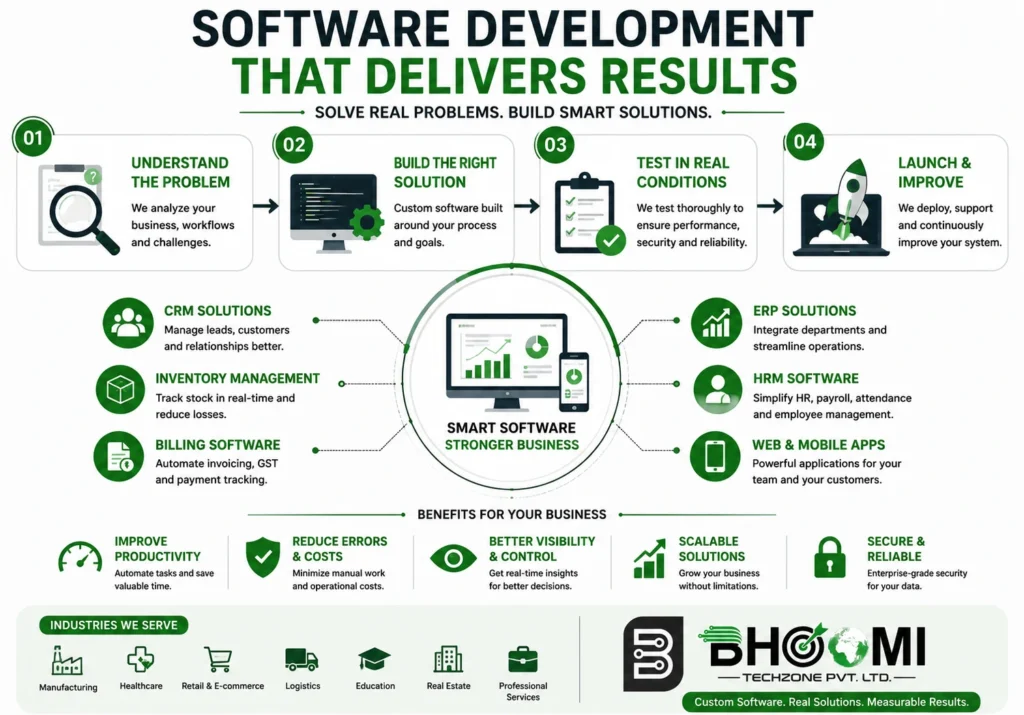
A software development company in Delhi typically covers a range of work beyond just writing code: understanding a business’s specific operational problem, recommending whether custom or ready-made software fits better, designing the software’s structure and user experience, building and testing it, deploying it into daily use, and providing maintenance and updates afterward.
The quality of the first step – actually understanding the problem – tends to determine how useful everything that follows turns out to be. A technically well-built system solving the wrong problem is still, in practical terms, a failed project, regardless of which software development company in Delhi built it.
Common Business Problems Custom Software Can Solve
Different businesses run into strikingly specific operational bottlenecks that software can directly address:
- A manufacturing company losing track of raw material usage across multiple production lines
- A healthcare clinic double-booking patient appointments due to manual scheduling
- A retail business unable to see real-time stock levels across multiple store locations
- A logistics company relying on phone calls to coordinate driver routes and deliveries
- A professional services firm losing billable hours to manually compiled invoices
- An SME managing employee attendance and payroll through disconnected spreadsheets
Each of these represents a fairly specific, solvable problem – not a vague need for “digital transformation,” but a concrete operational gap that a particular type of software addresses directly.
Types of Software Businesses Can Develop
- CRM – tracks customer interactions, sales pipelines, and follow-ups, useful for businesses losing track of leads or client relationships
- ERP – coordinates operations across departments like finance, inventory, and procurement for businesses managing complex, interconnected processes
- Inventory Management Software – provides real-time stock visibility, useful for retailers, manufacturers, and distributors handling physical goods
- Billing Software – automates invoicing and payment tracking, reducing manual errors in financial record-keeping
- HRM Software – manages attendance, payroll, and employee records, replacing manual HR tracking prone to errors
- Web Applications – browser-accessible tools for internal operations or customer-facing services, without requiring app installation
- Mobile Applications – extend software access to field staff, delivery teams, or customers who need on-the-go functionality
- SaaS Platforms – subscription-based software products, relevant for businesses building a product to sell to other businesses or consumers
- AI-Powered Software – tools incorporating features like demand forecasting, automated categorization, or predictive maintenance alerts
Custom Software vs Ready-Made Software
| Factor | Custom Software | Ready-Made Software |
| Fit to Business Process | Built specifically around your workflow | May require adapting your process to the tool |
| Initial Cost | Higher upfront investment | Lower upfront, often subscription-based |
| Implementation Speed | Slower, requires development time | Faster, ready to configure and use |
| Ownership | Full ownership of the software and code | Dependent on vendor’s platform and terms |
| Scalability | Designed to scale with specific business needs | Limited by the vendor’s product roadmap |
| Integration | Built for your existing systems specifically | May have limited or generic integration options |
| Best Suited For | Businesses with unique or complex workflows | Businesses with fairly standard operational needs |
Neither option is inherently better – a small retail business with standard inventory needs may be well served by ready-made software, while a manufacturer with a unique production sequence may need something built specifically around that process by a software development company in Delhi with relevant experience.
The Software Development Process: From Requirement Analysis to Launch
A software project that delivers real results generally follows a structured sequence, not a rushed jump from idea to code:
- Requirement Analysis – understanding the actual business problem, current workflow, and what success looks like
- Planning and Architecture – deciding on technology stack, system structure, and how the software will scale
- UI/UX Design – designing interfaces around how the actual end users will interact with the system daily
- Development – building the software in structured phases, ideally with visibility into progress along the way
- Testing – checking functionality, performance, and security under conditions resembling actual use, not just ideal office conditions
- Deployment – releasing the software into live use, often in stages rather than all at once
- Maintenance and Support – ongoing updates, bug fixes, and improvements based on real usage patterns
Skipping or rushing steps one and five – requirement analysis and real-world testing – is one of the more common reasons software projects underperform after launch, as the Gurugram logistics example illustrates. This is really the process any reliable software development company in Delhi should be following consistently, not just when a client asks about it.
How to Choose the Right Software Development Company in Delhi
A few practical factors separate genuinely capable providers of software development in Delhi from ones that simply sound capable in a sales pitch:
- Do they ask detailed questions about your business before proposing a technical solution?
- Can they explain their development process clearly, including how they handle testing?
- Do they have experience with businesses of similar size or industry complexity?
- Is their pricing transparent and tied to actual project scope, rather than a vague lump sum?
- What does post-launch support look like, and is it included or billed separately?
Vague or evasive answers to more than one or two of these questions are worth taking seriously as a warning sign before signing a contract.
Why Work With a Software Development Company in Delhi?
Working with a software development company in Delhi can offer practical advantages for businesses that prefer closer collaboration during a project. While technical expertise and development processes remain the most important factors, local availability can make communication and coordination easier when required.
- Easier requirement discussions: Complex business workflows can sometimes be explained more clearly through direct discussions.
- Better understanding of the Delhi NCR business environment: A local team may be more familiar with the operational needs of businesses across Delhi NCR.
- Possibility of in-person workshops: For complex projects, face-to-face requirement sessions can help align business and technical teams.
- Ongoing local coordination when needed: Businesses may benefit from the option of local meetings during implementation, training, or major system updates.
Important: Local presence alone should not be the deciding factor. The right software development company in Delhi should also demonstrate strong technical expertise, a clear development process, transparent communication, and reliable post-launch support.
Factors Affecting Software Development Cost and Timeline
Cost and timeline for working with a software development company in Delhi depend on several variables:
- Overall complexity of the required features and workflows
- Number of user roles and permission levels needed
- Integrations required with existing systems or third-party APIs
- Level of custom UI/UX design versus standard templates
- Security and compliance requirements specific to the industry
- Whether the software needs both web and mobile versions
- Ongoing maintenance and support arrangements after launch
There’s no single fixed price or timeline that applies across projects – a simple internal tool for a five-person team costs and takes far less than a multi-department ERP system for a growing enterprise. Any specific estimate should come from a software development company in Delhi that has actually reviewed your requirements, not a generic quote given without understanding the project.
Technologies and Trends Businesses Should Consider
A handful of technology trends are shaping how modern software gets built, and it’s worth understanding them at a practical level rather than chasing buzzwords:
- AI features – increasingly used for demand forecasting, automated data categorization, and pattern detection in operational data
- Cloud infrastructure – enables remote access, easier scaling, and reduces dependency on physical servers
- Automation – handles repetitive tasks like notifications, reminders, and routine reporting
- APIs – allow software to connect with other tools, like payment gateways or third-party services, without building everything from scratch
- Scalable architecture – ensures the software can handle growing users or data volume without requiring a complete rebuild later
None of these technologies are useful in isolation – they matter when applied to an actual operational problem, not adopted simply because they’re current trends. A capable software development company in Delhi should be able to explain why a specific technology fits your project, not just that it’s modern.
Common Mistakes Businesses Make When Developing Software
- Starting development before requirements are properly documented
- Choosing a provider based purely on the lowest quote without evaluating fit
- Skipping real-world testing conditions, testing only in ideal office environments
- Not discussing source code ownership before the project begins
- Ignoring how end users will actually adopt and use the software daily
- Underestimating the need for ongoing maintenance after launch
- Adding excessive features that complicate the software beyond what’s actually needed
How Startups, SMEs, and Large Businesses Have Different Requirements
Startups often need a lean, focused MVP (minimum viable product) to test a specific business idea quickly, rather than a fully-featured system from day one.
SMEs typically reach a point where manual processes or disconnected tools start causing real friction, making a focused software solution – often addressing one core operational gap – worth the investment.
Large businesses generally need more comprehensive systems handling multiple departments, higher user volumes, and stricter security or compliance requirements, often requiring custom development to manage that complexity effectively.
How to Get Better Results from Your Software Development Project
- Document your actual workflow before development starts – including edge cases and exceptions, not just the ideal-case process
- Test with real end users, in real conditions – office testing doesn’t reveal how software performs for field staff on unreliable networks
- Assign a clear point of contact on your side – someone who understands the business well enough to answer developer questions quickly
- Plan for training and adoption from the start – the best software fails if the team using it isn’t properly onboarded
- Budget for post-launch support – issues discovered after real usage begins are normal, not a sign of failure
- Review progress at defined milestones – rather than waiting until the entire project is “done” to see the first working version
Software Development Across Delhi and the NCR Region
Businesses across Delhi, Noida, Gurugram, Ghaziabad, and Greater Noida span a wide range of industries and sizes, from early-stage startups to established manufacturing and logistics operations. A software development company in Delhi working across this region generally needs to accommodate quite different requirements – a startup needing a fast MVP looks very different from a manufacturer needing production tracking integrated with existing machinery.
Being locally based can help with in-person requirement discussions and faster on-site coordination when needed, though technical capability and process discipline generally matter more than physical proximity, particularly since much of the development and testing work happens remotely regardless of location – a point worth keeping in mind while comparing options for a software development company in Delhi.
Where Bhoomi Techzone Fits In
Bhoomi Techzone works with businesses across industries – startups, SMEs, manufacturing, healthcare, logistics, retail, and professional services – to build software solutions matched to specific operational problems rather than generic packages. The approach typically starts with understanding a business’s actual workflow and pain points before recommending whether custom software, a ready-made tool, or some combination makes the most sense.
Depending on what a business needs, this can involve Software Development for CRM, ERP, inventory, or fully custom systems, Website Development for businesses needing a client-facing or internal web application, and Mobile App Development for businesses needing field staff or customer-facing app access.
For businesses still working through priorities, IT Consulting helps clarify the right starting point, while IT Support Services and Website Maintenance support ongoing needs once a system is live.
Frequently Asked Questions
What does a software development company in Delhi actually do?
Beyond writing code, a software development company in Delhi typically covers requirement analysis, choosing between custom and ready-made solutions, design, development, testing, deployment, and ongoing maintenance and support after launch.
How do I know if my business needs custom software or a ready-made tool?
If your workflow fits reasonably well into existing software with minor configuration, ready-made tools are usually faster and cheaper. Custom software makes more sense when your process is genuinely unique or generic tools require constant workarounds.
How much does software development cost in Delhi?
Cost varies significantly based on complexity, features, integrations, and design requirements. A reliable software development company in Delhi should assess your specific requirements before quoting rather than offering a fixed price upfront.
How long does a typical software development project take?
Timelines depend on scope – a simple internal tool might take a few weeks, while a complex, multi-department system can take several months. A phased approach launching core functionality first can help reduce the wait before seeing value.
What’s the biggest risk in software development projects?
Skipping proper requirement analysis and real-world testing tends to be the most common reason projects underperform after launch, more so than technical execution issues.
Can startups afford custom software development?
Often, yes, particularly with a lean MVP approach that builds only the essential functionality needed to test an idea, rather than a fully-featured system from the outset.
Who owns the source code after a project is completed?
This should be explicitly stated in the contract before development begins. Businesses should confirm they retain full ownership rather than just a license to use the software.
Does software development include ongoing maintenance?
It should, though this is often billed as a separate ongoing arrangement rather than included in the initial project cost. Confirm this explicitly before signing a contract.
How does AI fit into modern software development?
Practically, through features like demand forecasting, automated data categorization, and pattern detection, rather than as a standalone product. AI works best when applied to a specific operational problem.
What questions should I ask a software development company before hiring them?
Ask about their requirement-gathering process, testing approach, pricing transparency, experience with similar projects, and what post-launch support looks like.
Is it better to work with a local software development company in Delhi, or does location not matter?
Local proximity can help with in-person discussions and faster coordination, though technical capability and communication quality generally matter more than physical location alone when choosing a software development company in Delhi.
How can businesses ensure their software project actually gets used after launch?
By involving actual end users early, testing under real conditions rather than ideal office scenarios, and planning for proper training and onboarding rather than treating adoption as an afterthought.
Final Thoughts
Working with a software development company in Delhi isn’t just about getting a technically functional product delivered on time – it’s about ending up with something that actually reduces manual work, improves decision-making, and gets used by the people it was built for. The businesses that get the best results tend to invest as much attention in requirement clarity and real-world testing as they do in choosing the right development partner.
If you’re evaluating a software project and want a practical conversation about what would genuinely fit your business, the Bhoomi Techzone team is happy to walk through your specific situation – no pressure, just a clear look at what’s realistic for your needs.
Written by: Bhoomi Techzone Content Team,
Reviewed by: Technology & Digital Solutions Team, Bhoomi Techzone Pvt. Ltd.
Company: Bhoomi Techzone Pvt. Ltd
Phone: +91 81307 87194
Address: A-43, A Block, Sector 63, Noida, Uttar Pradesh 201301
Website: https://bhoomitechzone.com/