Quick Answer: Digital transformation for traditional businesses is the gradual process of replacing manual, paper-based, or disconnected operations with integrated digital systems – covering automation, CRM, cloud tools, and reporting. It works best as a phased strategy addressing one operational bottleneck at a time, not a single, all-at-once overhaul.
A distributor we’ll call a typical mid-sized wholesale business bought a CRM two years ago, an accounting tool last year, and recently started using a separate app for delivery tracking. None of these tools talk to each other. Staff still re-enter the same customer order into two systems, and the owner still can’t get a single report showing what’s actually happening across sales, inventory, and deliveries on any given day. This is a common outcome when a business adopts individual tools without an underlying plan – more digital noise, not necessarily more clarity. Digital transformation for traditional businesses isn’t really about buying tools one at a time; it’s about sequencing change so each piece connects to the next.
This article focuses specifically on that process – how to plan, sequence, and execute digital transformation for traditional businesses without breaking what already works, rather than cataloging every tool available. If you’re still deciding which specific tools might fit your business, our guide on digital solutions for traditional businesses covers that ground in more depth.
Table of Contents
What Is Digital Transformation for Traditional Businesses?
Digital transformation for traditional businesses means rethinking how a business operates – not just adding software, but changing workflows so digital tools genuinely replace manual steps rather than sitting alongside them. Digitization, by contrast, is simply converting something physical into digital form, like scanning a paper invoice. Transformation goes further: it changes the actual process around that invoice, from creation to approval to payment.
This distinction matters because a lot of businesses stop at digitization – they have digital records, but the workflow around those records is still essentially manual, just with extra software layered on top. Genuine digital transformation for traditional businesses closes that gap between having digital records and actually working differently because of them.
Why Traditional Businesses Need Digital Transformation
The pressure to modernize rarely comes from a single dramatic event. It builds gradually:
- Competitors offering faster service or better customer visibility start winning business that used to be routine
- Manual reporting takes longer as transaction volume grows, delaying decisions that depend on it
- Staff turnover becomes riskier when critical business knowledge lives only in one person’s notebook or memory
- Customers increasingly expect digital payment options, online order tracking, or self-service portals
- The cost of fixing errors from manual data entry compounds as a business scales
None of this means transformation is urgent overnight. But businesses that treat digital transformation for traditional businesses as optional indefinitely often find themselves reacting to a crisis – a key employee leaving, a major error, a competitor pulling ahead – rather than choosing the timing themselves.
Common Challenges Traditional Businesses Face
Modernization efforts run into a fairly consistent set of obstacles:
- Employee resistance – staff comfortable with manual methods may see new systems as extra work rather than relief
- Legacy data – years of records in paper form or inconsistent spreadsheets are hard to migrate cleanly
- Budget uncertainty – without a clear plan, costs can spiral as tools get added reactively rather than strategically
- Wrong sequencing – implementing an ERP before basic processes are even documented often leads to a system nobody trusts
- Lack of internal ownership – without someone responsible for the transition, half-finished rollouts are common
Recognizing these challenges upfront doesn’t eliminate them, but it does mean a business can plan around them rather than being surprised partway through a digital transformation for traditional businesses.
Key Areas Where Traditional Businesses Can Adopt Digital Technology
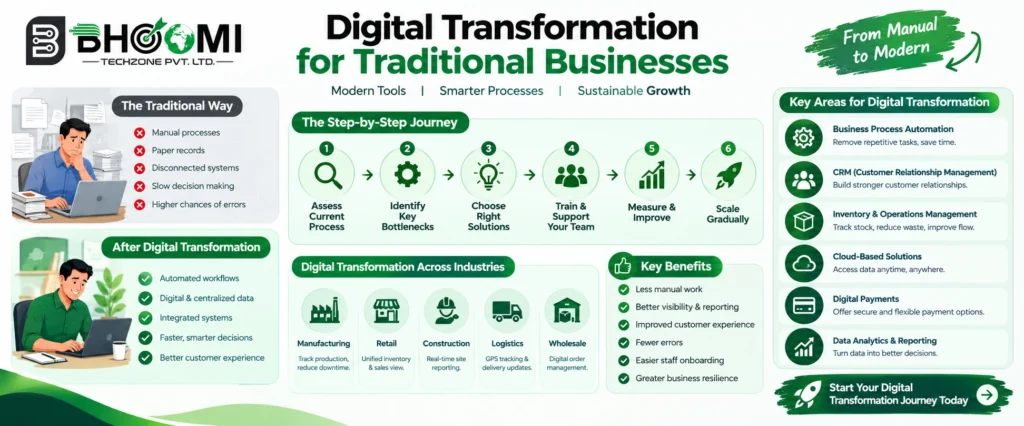
Business Process Automation
Automation removes repetitive manual steps – automatically routing an invoice for approval, sending order confirmations, or flagging low stock levels – without requiring a person to trigger each action individually. This is often the highest-value starting point because the time saved is immediate and easy to measure.
Customer Relationship Management
A CRM centralizes customer interactions, order history, and follow-ups in one place, replacing scattered notes and memory-dependent relationship management. The value shows up most clearly when a business has multiple people interacting with the same customers and needs a shared record of what’s already been said or promised.
Inventory and Operations Management
Digital inventory systems replace manual counts with real-time tracking, reducing both stockouts and the wasted capital tied up in overstocking. For manufacturing or wholesale businesses specifically, this often connects directly to production or purchasing decisions.
Cloud-Based Solutions
Moving records and systems to the cloud means data isn’t tied to a single physical location or device, which matters for businesses with multiple sites, remote staff, or a genuine need for backup protection against fire, theft, or hardware failure. Cloud adoption is often one of the earlier, lower-risk steps in a broader digital transformation for traditional businesses, since it doesn’t require changing how staff actually work day to day.
Digital Payments and Online Services
Accepting digital payments and offering basic online services – order status, appointment booking, simple self-service – reduces friction for customers who increasingly expect these options by default, particularly younger or urban customer bases.
Data Analytics and Reporting
Once information exists digitally, analytics turns it into something usable – spotting which products sell fastest, which customers are at risk of churning, or where bottlenecks slow down fulfillment. This step is often skipped because it requires digital data to already exist consistently across systems.
Benefits of Digital Transformation for Traditional Businesses
- Reduced time spent on repetitive manual tasks, freeing staff for higher-value work
- Better visibility into business performance through centralized, timely reporting
- Improved customer experience through faster response times and digital convenience
- Reduced errors from manual data entry and re-entry across disconnected tools
- Easier onboarding of new staff, since processes live in documented systems rather than individual memory
- Greater resilience against disruption, since digital records survive beyond a single physical location or person
These benefits build gradually rather than appearing immediately after a system goes live, which is worth setting realistic expectations around from the start of any digital transformation for traditional businesses.
Digital Transformation Examples Across Traditional Industries
These examples show what digital transformation for traditional businesses actually looks like once it moves past planning and into practice:
Manufacturing: A factory replacing handwritten production logs with digital tracking per shift can identify which machines or processes cause the most downtime, informing maintenance schedules rather than reacting to breakdowns.
Retail: A multi-outlet retailer connecting point-of-sale systems across locations gains a single view of stock and sales, instead of manually reconciling numbers from each store separately at month-end.
Construction: A contractor using a mobile app for site reporting – material deliveries, labor attendance, progress photos – reduces disputes with clients and gives project managers real visibility without daily site visits.
Logistics: A transport business adopting GPS-based tracking and digital delivery confirmations reduces disputes over delivery timing and gives clearer data on fleet utilization.
Wholesale: A distributor replacing phone-and-notebook order taking with a digital order management system reduces lost orders and gives sales staff an accurate, shared view of what’s actually been committed to each customer.
How to Start Digital Transformation Step by Step
- Map current processes – document how work actually happens today, including workarounds and exceptions, not just the ideal version
- Identify the biggest bottleneck – pick the single process causing the most repeated frustration or lost time
- Choose a focused solution – select a tool addressing that specific bottleneck rather than a sprawling, all-in-one platform
- Run a pilot – test with one team, one location, or one process before rolling out company-wide
- Train hands-on – walk staff through the new system directly rather than relying on a manual or a single demo session
- Measure results – check whether the pilot actually reduced the original pain point before expanding
- Expand deliberately – move to the next bottleneck only once the current change is stable and adopted
This sequence treats digital transformation for traditional businesses as an ongoing series of deliberate steps rather than one large, high-risk project – which tends to reduce both cost overruns and staff resistance.
Common Digital Transformation Mistakes to Avoid
A handful of avoidable missteps account for most failed attempts at digital transformation for traditional businesses:
- Buying multiple disconnected tools without a plan for how they’ll eventually integrate
- Rolling out a major system company-wide without piloting it first
- Underestimating training time, assuming staff will “figure it out” on their own
- Choosing software based on features rather than actual fit with existing workflows
- Migrating legacy data without cleaning it up first, carrying old errors into the new system
- Treating the transition as a one-time project instead of an ongoing operational shift
How to Choose the Right Digital Solutions
A few practical questions help narrow down options once a specific bottleneck has been identified:
- Does this tool integrate with systems we already use, or will it create another data silo?
- Can our current team realistically learn and adopt this within a reasonable timeframe?
- Does the provider offer training and ongoing support, or just the software itself?
- Is the solution scalable, or will we need to replace it again once the business grows?
- What does the total cost look like, including implementation, training, and ongoing maintenance – not just the license fee?
Providers offering thoughtful digital solutions for traditional businesses should be able to answer these questions specifically for your operation, rather than pointing to generic feature lists – the same standard worth applying to any partner supporting your broader digital transformation for traditional businesses.
Frequently Asked Questions
What is digital transformation for traditional businesses?
It’s the process of restructuring manual or disconnected business operations around integrated digital systems – automation, centralized data, and cloud tools – rather than simply digitizing individual documents or tasks in isolation.
Why do traditional businesses need digital transformation?
Growing transaction volume, competitive pressure, and rising customer expectations for digital convenience make manual processes increasingly costly to maintain, even when they’ve worked reliably for years.
How can traditional businesses start digital transformation?
By mapping current processes, identifying the single biggest operational bottleneck, piloting a focused solution for that specific problem, and expanding gradually once each change proves stable.
What are the benefits of digital transformation?
Reduced manual work, better visibility into performance, fewer data-entry errors, improved customer experience, and easier onboarding of new staff through documented, system-based processes.
How much does digital transformation cost?
Cost varies widely depending on the number of processes involved, the complexity of systems chosen, and training needs. A phased approach generally spreads cost over time rather than requiring one large upfront investment.
What technologies can traditional businesses use?
Common starting points include process automation tools, CRM systems, cloud-based record keeping, digital payment acceptance, inventory management software, and basic reporting or analytics tools.
How long does digital transformation take?
There’s no fixed timeline, since it depends on how many processes need to change and how complex each one is. A staged approach, addressing one process at a time, often shows initial results within weeks rather than requiring a multi-year plan before any benefit appears.
What’s the difference between digitization and digital transformation?
Digitization converts something physical into digital form, like scanning a document. Digital transformation for traditional businesses goes further, restructuring the actual workflow around that information rather than just changing its format.
How do you get employees on board with digital transformation?
Involve staff early in identifying pain points, provide hands-on training rather than one-time demos, and start with changes that visibly reduce their daily workload rather than adding new steps.
Can small traditional businesses afford digital transformation?
Yes, particularly when approached in stages. Starting with one affordable, focused tool addressing a clear bottleneck is generally more realistic for smaller budgets than a comprehensive system rollout.
What usually causes digital transformation to fail?
Rolling out major changes company-wide without piloting them, underestimating training needs, and buying disconnected tools without a plan for how they’ll eventually work together are among the most common causes.
Should digital transformation happen all at once or gradually?
Gradually, in almost all cases. A phased approach reduces disruption, gives staff time to adjust to each change, and allows a business to correct course if an early choice doesn’t work as expected.
Final Thoughts
Digital transformation for traditional businesses succeeds less because of which specific tools get chosen and more because of how deliberately the change is sequenced. Businesses that map their actual bottlenecks, pilot solutions before scaling them, and train staff properly tend to see steadier, more lasting results than those chasing every new tool that becomes available.
If you’re trying to figure out where to start or how to sequence a broader transformation, the Bhoomi Techzone team is happy to walk through your specific operations – no pressure, just a practical conversation about what would genuinely move the needle for your business.
Written by: Bhoomi Techzone Content Team,
Company: Bhoomi Techzone Pvt. Ltd.
Phone: +91 81307 87194
Address: A-43, A Block, Sector 63, Noida, Uttar Pradesh 201301
Website: https://bhoomitechzone.com/