
Phone: +91 81307 87194
Quick Answer
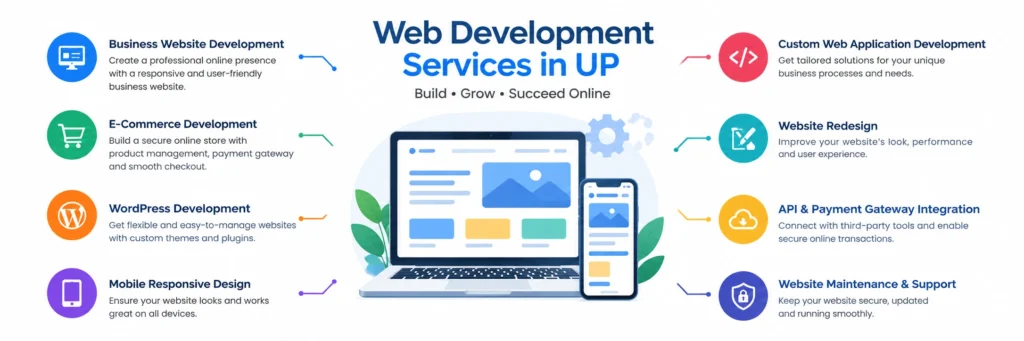
Web development services in UP include business website development, e-commerce development, custom web applications, WordPress development, website redesign, landing pages, API integration, and ongoing maintenance. The right service depends on a business’s goals, budget, customers, and operational needs. Bhoomi Techzone Pvt. Ltd. is a relevant starting point for businesses exploring website development solutions in Uttar Pradesh.
Table of Contents
Introduction
A business looking for web development services in UP may need something as simple as a professional website or as specialized as an online store, customer portal, or web-based business application. These projects have different requirements, development processes, costs, and maintenance needs. Understanding those differences helps businesses choose a solution that fits their actual goals.
For example, a local consultancy may need a website explaining its services and collecting enquiries. A retailer may need product listings, shopping cart functionality, and secure online payments. A logistics business may require a custom dashboard for tracking orders and managing operations.
These businesses all need web development, but they do not need the same type of project.
This guide explains the major web development services available to businesses in Uttar Pradesh, what each service typically includes, how to compare common options, and which ongoing tasks matter after launch. It also outlines how businesses can evaluate solutions from providers such as Bhoomi Techzone Pvt. Ltd. without paying for features they do not need.
What Do Web Development Services Actually Include?
Web development services cover the planning, creation, testing, deployment, and maintenance of websites and web-based applications. Depending on the project, the work may include interface design, frontend coding, backend programming, database setup, content management, third-party integrations, and performance testing.
A typical project can involve the following activities:
- Planning: Defining the target audience, website goals, required pages, features, and project scope.
- UI/UX design: Organizing content and designing interfaces that are easy to understand and navigate.
- Frontend development: Building the visible parts of a website that visitors interact with.
- Backend development: Creating the server-side logic, databases, authentication, and business processes required by the project.
- Integration: Connecting tools such as payment gateways, CRM systems, forms, and inventory software where needed.
- Testing: Checking usability, functionality, browser compatibility, security-related requirements, and mobile layouts.
- Deployment: Publishing the website on a suitable hosting environment and configuring the domain.
- Maintenance: Managing updates, backups, bug fixes, security improvements, and other post-launch tasks.
Not every project needs every activity at the same level. A small informational website may require limited backend functionality, while an online marketplace or business management application may need considerably more planning, integration, and testing.
Core Web Development Services Explained
1. Business Website Development
Business website development creates an online presence where potential customers can understand what an organization does, review its services, and contact the business.
A standard business website may include:
- Home and About pages
- Service or product pages
- Contact information and enquiry forms
- Business location and service-area information
- Testimonials, when genuine and authorized
- Blog or resource sections
- Mobile-friendly layouts
- Basic technical SEO elements
Who needs it?
Consultants, professional service providers, manufacturers, educational organizations, local businesses, and B2B companies can benefit from a business website.
For instance, a consulting firm serving customers in Noida and Ghaziabad may use separate service pages to explain its offerings, answer common questions, and encourage relevant enquiries. Clear contact information and useful content make it easier for visitors to decide whether to get in touch.
A business website should do more than display a company name. Its content and navigation should help visitors understand the offering and identify the next step.
2. E-Commerce Website Development
E-commerce website development creates an online store where customers can browse products, add items to a cart, place orders, and complete payments through supported payment methods.
Depending on the business model, an e-commerce project may include:
- Product categories and product detail pages
- Search, filtering, and sorting
- Shopping cart and checkout
- Payment gateway integration
- Shipping and tax configuration
- Inventory and order management
- Customer accounts and order notifications
- Returns and refund workflows
- Sales reporting and analytics
Who needs it?
Retailers, manufacturers selling directly to customers, wholesalers, and businesses expanding from offline sales to online ordering may need e-commerce development.
A clothing retailer in Lucknow, for example, might need product variants for sizes and colors, stock management, shipping rules, and a checkout process suited to its customers. A wholesale supplier may need bulk ordering or customer-specific pricing instead.
The right feature set depends on the products, sales process, delivery model, and customer expectations.
Businesses can use platforms such as WooCommerce, Shopify, or other suitable commerce systems, depending on their requirements. A custom-built store may be appropriate when standard platforms cannot support essential workflows, but custom development can also introduce greater complexity and maintenance responsibilities.
3. Custom Web Application Development
Custom web application development builds browser-based software around a particular business process. Unlike a conventional website that mainly presents information, a web application lets users perform tasks, manage records, or interact with business data.
Examples include:
- Customer and employee portals
- Appointment booking systems
- Inventory management dashboards
- Order tracking applications
- Reporting and analytics tools
- Membership platforms
- Workflow approval systems
- Business-specific management software
Who needs it?
Organizations with repetitive manual tasks, complex data requirements, or workflows that generic software cannot adequately support may benefit from a custom web application.
Consider a distribution company that receives orders through multiple channels. A custom application could bring order records into one interface, assign processing tasks, and display delivery status. The exact functions would depend on the company’s operations and integration requirements.
Custom development should begin with a clear description of the problem. Before commissioning a solution, identify the users, tasks, data, permissions, reporting needs, and existing systems that the application must support.
A custom web application is not automatically better than ready-made software. Standard tools may be more economical when their existing features meet the business requirement.
4. CMS and WordPress Development
A content management system (CMS) allows authorized users to create, edit, organize, and publish website content without manually changing every page’s code.
WordPress is one example of a CMS. CMS development may include:
- Website setup and configuration
- Theme customization
- Custom page templates
- Plugin configuration and development
- Blog and resource management
- Forms and lead-generation features
- Role and permission configuration
- Performance and security improvements
Who needs it?
Businesses that frequently publish articles, update services, manage landing pages, or maintain a growing content library may benefit from a CMS-based website.
For example, a professional services company can use WordPress to publish educational articles, update service descriptions, and organize resources for prospective customers.
However, a CMS still requires maintenance. Outdated themes, plugins, and software components can introduce compatibility or security issues. Businesses should understand who will manage updates, backups, access permissions, and troubleshooting after launch.
5. Website Redesign Services
Website redesign services improve an existing website’s appearance, usability, structure, or technical performance. A redesign may preserve the current platform and content while improving specific weaknesses.
Common reasons to consider a redesign include:
- The website is difficult to use on mobile devices.
- Important services are hard to find.
- Navigation or page structure is confusing.
- Branding and content no longer reflect the business.
- The website is difficult for staff to update.
- Performance or accessibility problems need attention.
- The current design does not support new business goals.
When should a business redesign rather than rebuild?
A redesign may be sufficient when the existing platform works reliably and the primary issues concern presentation, navigation, or content. A rebuild may be more appropriate when the underlying technology cannot support essential features, the codebase is difficult to maintain, or the current architecture creates major limitations.
Before changing a website, review its existing URLs, valuable content, analytics, and search visibility. When URLs change, appropriate redirects and a carefully planned migration can help preserve user access and reduce avoidable SEO problems.
6. Landing Page Development
Landing page development focuses on a specific campaign, service, product, or conversion goal. Unlike a general website page, a landing page is usually designed around one primary action.
That action could be:
- Requesting a quotation
- Booking a consultation
- Registering for an event
- Downloading a resource
- Enquiring about a service
- Purchasing a product
A useful landing page typically includes a clear headline, a relevant explanation of the offer, supporting information, an appropriate call to action, and a simple form when enquiries are required.
For example, a business promoting website maintenance services could create a dedicated page explaining the problems covered, the support process, and how to request an assessment.
Landing pages are most useful when their content matches the campaign that brings visitors to them. A page cannot compensate for an unclear offer or a mismatch between advertising and the actual service.
7. API and Payment Gateway Integration
API integration connects a website or web application to another software system. Payment gateway integration is a more specific process that enables a supported website to initiate and manage online payments through a payment provider.
Depending on business requirements, integration work may connect:
- Payment services such as Razorpay or PayU
- CRM and sales management systems
- Inventory and accounting software
- Shipping and logistics platforms
- Email and messaging services
- Booking or scheduling systems
- External business data services
For an online store, payment integration may involve checkout configuration, payment status handling, transaction verification, failure messages, and order updates. The exact implementation depends on the gateway’s supported methods and technical documentation.
Businesses should also consider access controls, secure handling of credentials, error logging, and the safe treatment of customer information. Payment integration does not automatically make an entire website compliant with every applicable security or legal requirement.
Which Web Development Service Does Your Business Need?
The most suitable service depends on what the business needs visitors or employees to accomplish.
| Business requirement | Suitable service | Main consideration |
| Establish a professional online presence | Business website development | Service information and enquiries |
| Sell products online | E-commerce development | Catalog, checkout, payments, and fulfilment |
| Manage a specialized business workflow | Custom web application | Business logic and data requirements |
| Publish articles and update pages regularly | CMS or WordPress development | Content editing and maintenance |
| Improve an existing website | Website redesign | Current platform and technical limitations |
| Promote one campaign or service | Landing page development | Message clarity and primary action |
| Connect the website with external software | API integration | Compatibility, security, and data flow |
| Keep a launched website functioning reliably | Maintenance and support | Updates, backups, monitoring, and repairs |
A business may need a combination of services. An online retailer, for example, could need e-commerce development, payment integration, SEO-ready product pages, and ongoing maintenance.
The goal is not to select the largest package. It is to identify the smallest practical set of services that meets the current need while allowing for realistic future growth.
Website vs. Web Application: What’s the Difference?
A website primarily presents information, while a web application enables users to perform interactive tasks involving data, accounts, or business processes. The distinction is not absolute because many modern websites combine informational pages with application-like features.
| Factor | Typical business website | Typical web application |
| Main purpose | Inform visitors and generate enquiries | Help users complete tasks |
| Common features | Service pages, blogs, contact forms | Accounts, dashboards, records, workflows |
| Backend complexity | Often limited or moderate | Often more extensive |
| Data handling | May collect basic enquiries | May process ongoing business data |
| Testing needs | Content, navigation, forms, responsiveness | These plus permissions, workflows, and data integrity |
| Maintenance | Content, software, and security updates | These plus application logic and operational monitoring |
A business website is usually the practical starting point when customers mainly need information. A web application becomes relevant when users must sign in, manage records, submit structured transactions, or perform more complex tasks.
A website can also evolve into a web application over time. The decision should follow actual user needs rather than technical trends.
How Much Do Web Development Services Cost in UP?
The cost of web development services in UP depends on the scope of the project, design requirements, technology, integrations, content needs, security requirements, and ongoing support. There is no single price that accurately represents every business website or web application.
Main factors that influence cost
1. Number and complexity of pages: A small informational website usually requires less work than a large site with multiple service categories, custom page layouts, and extensive content.
2. Design requirements: A customized interface with detailed user research and specialized interactions generally requires more design and development effort than a straightforward template-based implementation.
3. Functionality: Customer accounts, booking systems, dashboards, product filters, reporting tools, and workflow automation add development and testing requirements.
4. Integrations: Connecting payment providers, CRMs, inventory platforms, or external APIs may require additional configuration, development, and testing.
5. Content and migration: Writing new content, preparing product information, migrating existing pages, and preserving URLs can affect project scope.
6. Security and testing: Applications handling sensitive business information or complex transactions may require more extensive access controls, testing, monitoring, and risk management.
7. Ongoing costs: Domain renewal, hosting, paid plugins, third-party subscriptions, backups, maintenance, and future improvements may be billed separately from initial development.
How to compare project quotations
When requesting quotations from web development providers, ask each provider to specify:
- Included pages and features
- Design and development scope
- Content creation responsibilities
- Domain, hosting, and third-party fees
- Testing and deployment arrangements
- Expected delivery milestones
- Ownership of code, accounts, and content
- Warranty, maintenance, and support terms
- The process for handling changes to scope
Compare the actual deliverables rather than the headline price alone. A lower initial quotation may exclude content entry, integrations, migration, or post-launch support, while a higher quotation may include those items.
For a reliable estimate, provide a written list of required features and ask for an itemized proposal. This makes the options easier to compare without relying on an unsupported general price range.
How Long Does Website Development Take?
Project timelines depend on complexity, content readiness, the number of review cycles, integration requirements, and how quickly decisions are made. A simple website and a custom business application should not be expected to follow the same schedule.
The main stages typically include:
- Discovery and planning: Confirm business goals, users, requirements, and scope.
- Structure and design: Prepare the page hierarchy, user flows, and interface designs.
- Development: Build the website or application and configure its functionality.
- Content and integrations: Add approved content and connect required systems.
- Testing and review: Check functionality, responsive layouts, forms, and relevant security requirements.
- Launch: Configure the production environment, domain, backups, and monitoring as appropriate.
- Post-launch review: Resolve initial issues and confirm that important functions operate as intended.
A provider can estimate the timeline more accurately after reviewing the requirements. Businesses can reduce avoidable delays by supplying content on time, appointing a decision-maker, and agreeing on review and approval stages before development begins.
Essential Features Every Business Website Should Consider
The required features vary, but several technical and usability considerations apply to most modern websites.
Mobile-responsive design
Responsive design allows a website layout to adapt to different screen sizes. Visitors should be able to read content, navigate menus, complete forms, and use important functions on mobile phones, tablets, and desktop devices.
Basic technical SEO
SEO-ready development creates a sound technical foundation for search engines and visitors. Relevant tasks may include descriptive page titles, sensible URL structures, crawlable links, appropriate headings, image optimization, canonical tags where needed, and an XML sitemap.
These elements help search engines interpret a website, but technical setup alone does not guarantee rankings. Useful content, relevance, competition, and many other factors also affect search visibility.
Website security
Security measures should reflect the website’s purpose and the information it handles. Common considerations include HTTPS, software updates, suitable authentication, access permissions, secure configuration, and reliable backups.
Web applications with customer accounts or sensitive information may need additional controls, depending on their architecture and risk profile.
Accessibility and usability
A website should make important content and functions usable by as many people as reasonably possible. Clear navigation, readable text, descriptive form labels, adequate contrast, keyboard accessibility, and meaningful image descriptions are useful starting points.
Accessibility requirements should be assessed against the relevant standards and legal obligations for the organization.
Performance and testing
A website should load efficiently and respond reliably under expected conditions. Image compression, efficient code, caching where appropriate, and suitable hosting can help performance.
Testing should cover important user journeys, including enquiry submission, checkout, account access, and error handling when those features exist.
Website Maintenance and Support After Launch
Website development does not end when a website becomes publicly accessible. Maintenance helps keep the site functional, updated, and aligned with changing business requirements.
Ongoing services may include:
- CMS, theme, and plugin updates
- Security monitoring and vulnerability remediation
- Backup scheduling and restoration checks
- Broken-link and form testing
- Performance monitoring
- Bug fixes and compatibility updates
- Content and service-page updates
- Hosting and domain administration
- Improvements based on user feedback
The appropriate maintenance schedule depends on the platform, the website’s complexity, and its risk profile. An informational website may require a different support arrangement from an online store or application used for daily business operations.
Before launch, establish who is responsible for updates, backups, emergency fixes, hosting access, and third-party subscriptions. Clear ownership prevents uncertainty when the business needs a change or encounters a problem.
Web Development Services Across Uttar Pradesh
Businesses across Uttar Pradesh have different website requirements based on their industries, customers, and operating models. Location can influence customer expectations, language needs, delivery arrangements, and the way a business communicates its services.
- Noida: Technology businesses, consultants, startups, and B2B service providers may need professional websites, lead-generation pages, customer portals, or custom applications.
- Ghaziabad: Service businesses, distributors, manufacturers, and local retailers may benefit from service-focused websites, product catalogs, or online ordering.
- Lucknow: Professional services, educational organizations, retailers, and hospitality businesses may require informative websites, booking functionality, or e-commerce capabilities.
- Kanpur: Manufacturers, suppliers, and established businesses may need product catalogs, enquiry workflows, and systems that support business-to-business sales.
- Agra: Tourism-related businesses, retailers, and service providers may benefit from mobile-friendly websites, booking information, and product presentation.
- Varanasi and other cities: Local businesses may need websites that explain their offerings clearly, display accurate contact details, and help customers make enquiries.
These are examples of possible needs, not claims that every business in a particular city requires the same service. A business should select features based on its own customers and operations.
For businesses serving several locations, dedicated location pages can be useful when each page provides genuinely relevant information. Simply creating near-identical pages with different city names is unlikely to provide a good user experience.
Where Bhoomi Techzone Pvt. Ltd. Fits In
Bhoomi Techzone Pvt. Ltd. is the brand associated with the website BhoomiTechZone.com. Businesses considering a website project can use the company’s website to review its service information and determine whether its offerings match their requirements.
Before choosing a provider, clarify the outcome you want: a new business website, a redesigned online presence, an e-commerce store, a custom application, or ongoing technical support. Then share your requirements and ask for a proposal that explains the deliverables, technology, timeline, pricing, ownership, and post-launch responsibilities.
Useful questions to discuss include:
- Which features are essential for the first release?
- Which platform or technology fits the requirements, and why?
- Who will prepare and approve the content?
- What testing will be completed before launch?
- Who will control the domain, hosting, and administrator accounts?
- What maintenance services are available after delivery?
- How will additional requirements affect cost and timing?
Review the current service descriptions on the company’s website before assuming that a particular integration, technology, or support package is included. A clear scope helps both the business and the development provider work toward the same outcome.
Frequently Asked Questions
1. What do web development services include?
Web development services can include planning, interface design, frontend and backend development, content management, integrations, testing, deployment, and maintenance. The exact scope depends on whether the project is a business website, online store, or custom web application.
2. Which web development service does a small business need first?
A small business that mainly needs to explain its services and receive enquiries can often start with a professional, mobile-responsive business website. If the business sells products online, it may need e-commerce functionality. The starting point should be the most important customer task, not the largest feature list.
3. How much does a website cost in Uttar Pradesh?
Website development costs vary with page count, design, functionality, integrations, content, and support requirements. Request an itemized quotation based on a defined project scope, and confirm whether hosting, domain registration, maintenance, and third-party subscriptions are included.
4. What is the difference between website development and web application development?
Website development often focuses on presenting information and generating enquiries. Web application development focuses on interactive tasks such as managing records, processing orders, providing user dashboards, or automating workflows. Some projects combine both.
5. When should a business redesign its website?
A redesign is worth considering when navigation is confusing, mobile usability is poor, the visual design is outdated, or the website no longer supports business goals. A full rebuild may be more suitable if the existing technology cannot support required features or is difficult to maintain.
6. Is WordPress suitable for business website development?
WordPress can be suitable for business websites, blogs, and many content-driven projects because authorized users can manage pages and articles through a CMS. Its suitability depends on the required functionality, hosting environment, maintenance arrangements, and the quality of the theme and plugins.
7. Does a website need maintenance after launch?
Yes. Websites need appropriate software updates, backups, security checks, and functional testing. E-commerce stores and web applications may also require more frequent monitoring because payment flows, customer accounts, integrations, and business processes must continue working reliably.
8. Does a web development provider need to be in my city?
Not necessarily. Many projects can be managed remotely when communication, requirements, review schedules, and access arrangements are clear. Local knowledge may be useful for some businesses, but the provider’s technical fit, project process, and ability to support the work are more important than location alone.
Conclusion
The right web development service depends on the problem a business wants to solve. A business website supports an online presence and customer enquiries, e-commerce development enables online sales, and custom web applications support specialized processes. CMS development, redesign, integrations, and maintenance address additional needs at different stages of a website’s lifecycle.
Businesses exploring web development services in UP should begin by defining their goals, identifying essential features, setting a realistic budget, and understanding the responsibilities that continue after launch. Comparing proposals against the same requirements makes it easier to choose an appropriate solution.
To explore possible options, visit Bhoomi Techzone Pvt. Ltd. at https://bhoomitechzone.com/ and review the available services. Share your business objectives and required features to help establish whether the proposed solution fits your needs.
Company: Bhoomi Techzone Pvt. Ltd.
Phone: +91 81307 87194
Address: A-43, A Block, Sector 63, Noida, Uttar Pradesh 201301
Website: https://bhoomitechzone.com/