
Phone: +91 81307 87194
Quick Answer: Content marketing helps local businesses improve search visibility, answer customer questions before they even make contact, and build trust through genuinely useful information. Over time, this leads to more relevant inquiries, stronger local brand recognition, and organic traffic that keeps generating leads without ongoing ad spend.
A local accounting firm and a local restaurant have almost nothing in common operationally, yet both run into the same problem: potential customers who’ve never heard of them are searching online for exactly what they offer, and finding a competitor’s blog post or FAQ page instead of theirs. That’s really the gap this article addresses — not how to build a content plan (that’s a separate topic), but how content marketing helps local businesses actually get found, trusted, and contacted in the first place.
Table of Contents
What Is Content Marketing for Local Businesses?
Content marketing for a local business means creating genuinely useful information—blog posts, guides, FAQs, videos—built around real customer questions, rather than posting occasional promotional updates on social media. The distinction matters: a post announcing a sale is advertising. An article explaining “what to check before hiring an electrician” is content marketing, because it helps the reader regardless of whether they choose your business.
This is also different from generic blogging. Content that genuinely helps local customers reflects specific, relevant information—pricing factors, local considerations, common mistakes—rather than vague statements that could apply to any business in any city. This distinction is really the difference between content marketing for local businesses and a competitor publishing generic filler.
How Content Marketing Helps Local Businesses
The benefits below aren’t abstract marketing claims—each one reflects a specific, practical mechanism worth understanding before deciding how much to invest in this channel.
Improves Local Search Visibility
Useful content targets the actual searches your potential customers are typing in, giving your business more opportunities to appear in organic search results beyond just your homepage. A plumbing business writing about “signs your water heater needs replacing” can show up for that exact question, not just for “plumber near me.”
Helps Customers Discover Your Business
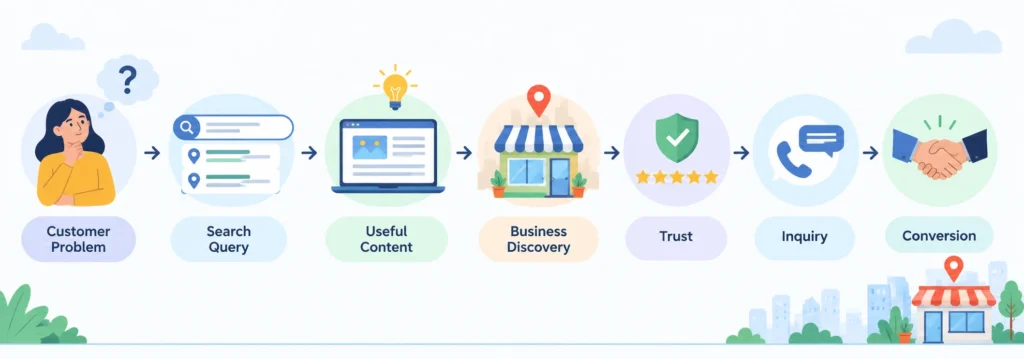
The path usually looks like this: a customer has a problem, searches for it, finds content that actually addresses it, and discovers the business behind that content in the process. This is one of the clearest illustrations of local content marketing at work — getting a business in front of people who weren’t specifically searching for them by name.
Builds Trust and Credibility
Educational content, clear service explanations, and honest FAQs reduce the uncertainty a potential customer feels before reaching out. A business that clearly explains how its pricing works or what a typical project involves comes across as more trustworthy than one that only says “contact us for a quote.” This trust-building effect is where useful business content really earns its keep, turning casual visitors into serious inquiries.
Educates Potential Customers
Good content answers questions before a sales conversation even starts — what a service actually involves, what affects cost, what to expect during the process. By the time a genuinely informed customer reaches out, they’re further along in their decision than someone cold-calling around for quotes.
Generates More Qualified Leads
There’s a real difference between attracting visitors and attracting people who actually need what you offer. Content built around specific customer problems tends to attract the second group — people already close to needing your particular service, not just casual browsers. This is exactly what makes local content marketing more efficient than broad, untargeted traffic — better-fit inquiries instead of just more clicks.
Supports Local SEO
Relevant, well-structured content gives search engines more reason to associate your website with the topics and services you actually offer. This isn’t a guarantee of rankings on its own, but it’s a meaningful contributor alongside other local SEO fundamentals — a clear illustration of how content marketing helps local businesses build durable search presence.
Increases Local Brand Awareness
Repeated, useful exposure — through search results, social sharing, and Google Business Profile posts — makes a business more recognizable over time, even among people who haven’t contacted you yet. Recognition built this way tends to feel more earned than a generic ad impression.
Helps Customers Make Better Buying Decisions
Comparison guides, checklists, and service explainers give customers the confidence to choose, rather than leaving them to guess. A real estate business explaining “questions to ask before buying a resale flat” helps a buyer feel prepared to actually move forward.
Creates Long-Term Organic Value
A well-written, genuinely useful article can keep attracting search traffic well after it’s published, unlike a paid ad that stops the moment the budget runs out. Performance still varies by topic, competition, and how much people are actually searching for it — this isn’t automatic for every piece.
Supports Customer Retention
Guides, FAQs, and useful updates don’t just help new customers — they continue serving existing ones, reducing repetitive support questions and reinforcing that a business remains a genuinely useful resource after the sale. It’s a reminder that how content marketing helps local businesses doesn’t stop once the first sale is made.
How Local Content Helps Customers Discover a Business
The underlying chain looks like this: problem → search → content → discovery → trust → inquiry → conversion. A business owner searching “website development company in Noida” or “CRM software for small businesses” isn’t necessarily ready to buy yet — they’re trying to understand their options. Content that genuinely helps answer questions like “how to choose accounting software for a small business” or “digital marketing services near me” puts a business directly in front of that research process.
What matters here is search intent, not just inserting a city name into a page. A page titled “Web Development Noida” with generic content underneath doesn’t help anyone the way a genuinely useful explanation does — this is exactly how content marketing helps local businesses build real relevance, not just superficial keyword presence.
Types of Content That Help Local Businesses
| Content Type | Main Purpose |
| Local SEO blogs | Search visibility |
| Service guides | Customer education |
| FAQs | Answering specific questions |
| How-to articles | Problem solving |
| Comparison content | Decision support |
| Case studies | Trust and proof |
| Customer guides | Education |
| Location-specific content | Local relevance |
| Google Business Profile posts | Local engagement and discovery |
| Social media content | Awareness and engagement |
| Videos | Demonstration and explanation |
| Testimonials and customer stories | Trust |
Content Marketing Examples for Different Local Businesses
Local IT Company: A business struggling with disconnected tools finds an article explaining how CRM software solves that specific problem, which leads them to reach out to understand their own options better.
Healthcare Business: A clinic publishes content explaining what to expect before a specific procedure, helping anxious patients feel prepared — without making specific medical claims about outcomes.
Real Estate Business: A property consultant writes local buyer guides covering typical questions about a specific area, helping prospective buyers narrow down their search with more confidence.
Restaurant or Food Business: A restaurant shares content around local food guides or seasonal menu updates, giving people a reason to think of them beyond a generic search for “restaurants near me.”
Retail Business: A retailer publishes buying guides comparing product options, helping shoppers make a decision instead of abandoning their search partway through.
Professional Services Business: A CA firm explains a confusing compliance requirement in plain language, positioning itself as genuinely helpful before any commercial conversation happens.
These are illustrative scenarios, not documented case studies — actual outcomes vary by business, competition, and execution.
Content Marketing vs Traditional Local Advertising
| Factor | Traditional Advertising | Content Marketing |
| Main approach | Paid promotional message | Useful information |
| Customer intent | Often interruption-based | Can capture existing search interest |
| Long-term value | Usually tied to active campaigns | Content may continue providing value |
| Search visibility | Usually limited unless separately optimized | Can contribute to organic visibility |
| Trust building | Depends on message and brand | Can demonstrate expertise over time |
| Content reuse | Campaign-dependent | Can often be reused across channels |
| Measurement | Impressions, clicks, leads | Traffic, engagement, leads, conversions |
Neither approach is universally better — many local businesses benefit from combining both rather than choosing one over the other entirely.
How Content Marketing Supports Local SEO
Content connects to local SEO through several related factors: matching content to local search intent and keywords, building internal links between related pages, staying consistent with your Google Business Profile, and reinforcing topical relevance around your actual services. Reviews and local citations also play a role in how trustworthy a business appears to both customers and search engines.
Content marketing supports local SEO, but it doesn’t replace the fundamentals — an accurate Google Business Profile, consistent business information across platforms, and genuine local relevance still matter just as much as the content itself. Keeping this balance in view is part of understanding how content marketing helps local businesses without overpromising what content alone can achieve.
How Long Does Content Marketing Take to Help a Local Business?
Some benefits show up quickly — a well-written guide can educate a customer or get shared within days of publishing. Organic search visibility typically takes longer, often building gradually over months rather than weeks, since search engines need time to index and evaluate new content relative to competitors.
Results depend on factors like competition in your industry, your website’s existing authority, content quality, consistency, and actual search demand for your topics. There’s no guaranteed timeline, and any promise of rankings within a fixed number of days should be treated with caution.
How to Create Content That Actually Helps Local Customers
A short, practical checklist rather than a full strategy framework:
- Start with genuine customer questions, not assumptions
- Match content to what people are actually searching for
- Add relevant local context where it genuinely applies
- Provide specific, original information rather than generic statements
- Make content easy to scan, with clear headings and short paragraphs
- Add internal links to related pages on your site
- Include a clear, low-pressure next step for interested readers
- Update content when information or pricing changes
- Check whether the content is actually helping your intended audience
How to Measure the Impact of Content Marketing
Traffic alone isn’t a reliable measure of success — a page can receive plenty of visits while generating zero relevant inquiries. Worth tracking instead:
- Organic traffic and search impressions
- Click-through rate from search results
- Keyword visibility for targeted terms
- Engagement, including time spent on the page
- Leads, form submissions, calls, and WhatsApp inquiries where trackable
- Assisted conversions, where content played a role before the final contact
- Local search visibility and overall conversion rate
High traffic with zero relevant inquiries isn’t necessarily successful content, even if the numbers look impressive on a dashboard. Keeping this distinction in mind is essential to accurately judging how content marketing helps local businesses in practice, rather than relying on vanity metrics.
Common Content Marketing Mistakes Local Businesses Should Avoid
- Creating generic content that could apply to any business in any city
- Writing purely for keywords rather than for the actual reader
- Keyword stuffing, including overusing location names unnaturally
- Ignoring local search intent entirely
- Copying competitors’ content instead of addressing genuine gaps
- Creating thin, templated location pages with no real local value
- Publishing without understanding what customers actually ask
- Inconsistent publishing with long gaps between content
- Skipping internal linking between related pages
- Never updating older content as information changes
- Measuring success by traffic alone
- Using fake reviews or fabricated customer stories
- Expecting immediate rankings or leads
Frequently Asked Questions
How does content marketing help local businesses?
It improves search visibility, educates potential customers, builds trust through useful information, and creates ongoing opportunities for inquiries without relying solely on paid advertising. This is the core mechanism behind how content marketing helps local businesses grow sustainably over time.
Why is content marketing important for local businesses?
It helps a business get found by people actively searching for relevant services, answers questions before a sales conversation starts, and builds credibility that supports long-term customer relationships.
Can content marketing help a small local business?
Yes. Small businesses can find opportunities in specific local topics that larger competitors may not cover in depth, particularly when the content addresses genuine customer needs.
How does content marketing improve local SEO?
By providing relevant, well-structured content that search engines can associate with your services, supporting internal linking, and reinforcing topical relevance alongside other local SEO fundamentals.
What type of content should a local business create?
A mix of service guides, FAQs, how-to articles, and comparison content addressing real customer questions, rather than purely promotional posts.
How can local businesses attract customers through content?
By publishing genuinely useful information that answers the specific questions potential customers are already searching for, rather than generic content with a city name inserted.
Does content marketing help generate local leads?
Yes, though results build gradually. Content that addresses specific customer problems tends to attract people closer to actually needing the service, improving lead quality over time.
How long does content marketing take to show results?
Some benefits, like customer education, happen quickly. Organic search visibility typically takes months, depending on competition, content quality, and consistency.
What keywords should local businesses target?
A mix of service-specific and local search terms reflecting how real customers search, rather than broad, highly competitive terms alone.
How often should a local business publish content?
Consistency matters more than frequency — a realistic, sustainable schedule tends to work better than sporadic bursts of content followed by long gaps.
How does content marketing compare with traditional advertising?
They serve different purposes. Advertising delivers immediate, campaign-based visibility, while content marketing builds longer-term organic visibility and trust — many businesses benefit from using both together.
How can a local business measure content marketing results?
By tracking organic traffic, keyword visibility, engagement, and actual leads or inquiries generated — not traffic numbers alone.
Final Thoughts
The underlying idea is fairly simple: content builds visibility, visibility leads to education, education builds trust, and trust eventually turns into an inquiry and, sometimes, a customer. That is how a consistent content approach can support local business growth over time — not through a single viral post, but through a steady accumulation of genuinely useful content that can continue attracting and educating customers.
If your business needs help turning useful content into a consistent local marketing channel, Content Marketing Services in Noida covers what professional support for content creation, SEO optimization, and ongoing content management typically looks like.
Company: Bhoomi Techzone Pvt. Ltd
Phone: +91 81307 87194
Address: A-43, A Block, Sector 63, Noida, Uttar Pradesh 201301
Website: https://bhoomitechzone.com/