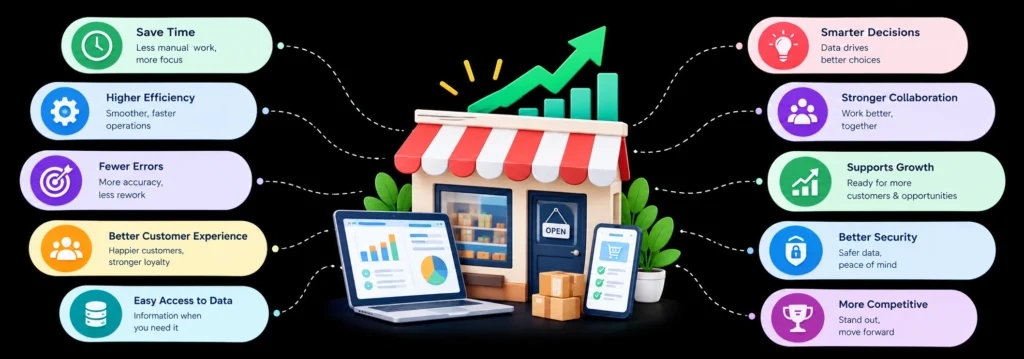
Quick Answer: The benefits of digital solutions for small businesses include less time spent on repetitive manual work, fewer errors from manual data entry, better visibility into business data, improved customer experience, and easier decision-making. Over time, organized digital systems also make it easier for a small business to scale operations without proportionally increasing manual effort.
A small business owner running a growing service company recently described her week this way: three different notebooks for customer follow-ups, a separate spreadsheet for invoicing, and a WhatsApp group serving as the de facto project tracker. None of it was broken exactly – it just took longer every month to do the same basic things. This is a common starting point, and it’s exactly where the benefits of digital solutions for small businesses actually show up: not in some dramatic transformation, but in the accumulated hours and errors saved once information stops living in five different places at once.
Table of Contents
What Are Digital Solutions for Small Businesses?
Digital solutions are tools that replace manual, paper-based, or disconnected business processes with organized digital workflows – a shared customer database instead of scattered notes, automated invoicing instead of manual calculations, a single dashboard instead of piecing together numbers from different sources. For a fuller look at the specific categories of tools available, Digital Solutions for Traditional Businesses covers that ground in depth. This article focuses on something different: the practical benefits these solutions actually create once they’re in place.
Why Digital Solutions Matter for Small Businesses
Small businesses typically operate with limited staff, limited time, and limited management capacity to catch every small inefficiency before it compounds. A five-person team doesn’t have the luxury of dedicating someone full-time to reconciling spreadsheets or chasing down a customer’s order history across three different channels. This is precisely why the benefits of digital solutions for small businesses tend to matter more, proportionally, than they do for a large enterprise with dedicated departments to absorb inefficiency. A well-organized system doesn’t just save time – it frees up management attention that would otherwise go toward firefighting basic administrative problems. This is where the value compounds over time, rather than showing up as one dramatic improvement.
Benefits of Digital Solutions for Small Businesses
Save Time by Reducing Manual Work
Manual, repetitive tasks – re-entering the same customer details, manually calculating invoice totals, copying numbers between spreadsheets – consume hours that add up fast. A retailer manually reconciling daily sales against inventory counts might spend an hour every evening on a task a connected point-of-sale system handles automatically. That hour, recovered daily, adds up to real time back in the owner’s week.
Improve Operational Efficiency
When information flows between systems instead of requiring manual re-entry at each step, work moves faster with fewer handoffs. A service business where a booking automatically updates the calendar, notifies the assigned staff member, and generates an invoice template removes several manual steps that previously depended on someone remembering to do them.
Reduce Human Errors
Manual data entry is inherently error-prone – a transposed number in an invoice, a missed line item, a customer record updated in one place but not another. Digital systems that update information in one place and reflect it everywhere reduce the chances of these small, recurring mistakes that otherwise require time to catch and fix later.
Improve Customer Experience
Customers notice when a business remembers their order history, responds quickly, or handles billing without confusion. A CRM that shows a customer’s full interaction history means any staff member can pick up a conversation without asking the customer to repeat themselves – a small detail that meaningfully affects how professional a business feels.
Make Business Data Easier to Access
Instead of a business owner needing to call three staff members to piece together “how many orders did we get this week,” organized systems can surface that information directly. This matters especially for owners who are pulled between operations and can’t spend time manually compiling numbers before every decision.
Support Faster and Better Decisions
Decisions made with actual data – which products are selling, which customers haven’t ordered recently, where costs are creeping up – tend to hold up better than decisions made on gut feeling alone. A distributor with real-time stock visibility can decide to reorder before running out, rather than discovering the shortage when a customer complains.
Improve Team Collaboration
When employees work from shared systems rather than personal notes and individual spreadsheets, handoffs between people become smoother. A project that moves between a salesperson, a project manager, and a technician benefits from all three seeing the same updated information rather than relying on someone remembering to forward an email.
Manage Customers More Effectively
Centralizing customer records – contact details, order history, past issues, preferences – means customer relationships don’t depend entirely on one employee’s memory or personal notes. If that employee is out sick or leaves the business, the relationship and its history remain intact.
Improve Inventory and Business Operations
Real-time inventory tracking replaces periodic manual counts, reducing both stockouts that lose sales and overstocking that ties up cash unnecessarily. A small manufacturer tracking raw material usage digitally can spot consumption patterns that would be nearly impossible to notice from handwritten logs.
Make Business Processes More Scalable
A process that depends entirely on one person’s memory or a specific spreadsheet format becomes a bottleneck the moment the business grows past what that person can manually handle. Digital systems designed to handle more users, more transactions, or more locations let a business absorb growth without needing to rebuild its core processes from scratch.
Support Remote and Flexible Work
Cloud-based systems mean staff aren’t tied to one physical computer or office to access business information. A business owner checking on order status while traveling, or a remote employee handling customer inquiries from home, both depend on this kind of accessibility.
Improve Business Security and Data Management
Properly implemented digital systems – with backups, access controls, and encrypted storage – tend to be more secure than paper records locked in a filing cabinet or customer data stored across personal devices. This isn’t automatic, though; security depends on how a system is set up and maintained, not just on going digital by default.
Help Small Businesses Compete More Effectively
Faster response times, more reliable service, and better-organized operations let a small business compete on service quality even against larger competitors with bigger budgets. A small business that responds to inquiries within the hour, backed by organized systems, can outcompete a slower-moving competitor regardless of company size.
How Digital Solutions Improve Everyday Business Operations
Customer management: Manual process – customer information scattered across notebooks, WhatsApp chats, and email threads. Digital process – a centralized CRM where any staff member can pull up a customer’s full history in seconds.
Invoicing: Manual process – calculating totals by hand and tracking payments in a spreadsheet. Digital process – automated invoicing software that generates, sends, and tracks payment status without manual recalculation.
Inventory: Manual process – physically counting stock periodically and estimating what’s likely still available. Digital process – real-time inventory tracking that updates automatically with every sale or restock.
Employee and task management: Manual process – assigning tasks verbally or through scattered messages, with no central record of what’s been completed. Digital process – a shared task board showing what’s assigned, in progress, and done.
Reporting: Manual process – manually compiling numbers from different sources before a monthly review. Digital process – a dashboard pulling the same data together automatically, available whenever it’s needed.
Communication: Manual process – information split across phone calls, personal messages, and email, with no single record. Digital process – a shared communication or project tool where relevant conversations are visible to everyone who needs them.
Business Need Possible Digital Solution Practical Benefit
| Business Need | Possible Digital Solution | Practical Benefit |
| Customer management | CRM | Organized, accessible customer information |
| Billing | Billing/invoicing software | Faster, more accurate record keeping |
| Inventory | Inventory management software | Better real-time stock visibility |
| Operations | ERP/business management software | Connected workflows across departments |
| Communication | Collaboration tools | Easier team coordination |
| Reporting | Dashboards/analytics | Faster, data-backed decision-making |
How Digital Solutions Can Help Reduce Business Costs
Cost savings from digital solutions tend to come from a few specific sources: less time spent on repetitive manual work, fewer costly errors that require correction, better inventory visibility that reduces both stockouts and overstocking, and less administrative overhead overall. A business spending fewer staff-hours reconciling records has more time available for revenue-generating work instead.
That said, digital solutions aren’t automatically cost-saving. Implementation, training, software subscriptions, and ongoing maintenance all carry real costs that need to be weighed against the time and error reduction a system actually delivers. A tool that’s too complex for the team to use properly can end up costing more in wasted time than the manual process it was meant to replace – a reminder that the benefits of digital solutions for small businesses depend heavily on proper fit and implementation, not the tool alone.
How Digital Solutions Improve Customer Experience
For service businesses, faster response times and organized follow-ups make customers feel prioritized rather than forgotten. For retail businesses, smoother checkout experiences and accurate order tracking reduce friction at the point of sale. For traditional businesses more broadly, simply having organized records means a customer’s question can be answered immediately rather than requiring a callback after someone digs through old files.
Personalization also becomes more practical once customer information is centralized – recognizing a repeat customer’s preferences, following up at the right time, or flagging a customer who hasn’t ordered in a while all depend on having that information organized somewhere accessible.
How Digital Solutions Support Business Growth
Organized systems make growth more manageable by turning ad hoc processes into repeatable ones. A business that can handle twenty customers using a spreadsheet often can’t handle two hundred the same way – but a proper CRM or order management system scales far more gracefully. Digital systems also make it easier to bring on additional employees, since new hires can be trained on a documented system rather than needing to absorb undocumented knowledge from an existing employee.
None of this means technology by itself causes growth – it creates a stronger operational foundation that makes growth easier to manage once it happens, rather than being the direct cause of it. Seen this way, the benefits of digital solutions for small businesses are more about removing friction than manufacturing growth out of nowhere.
Challenges Small Businesses Should Consider Before Going Digital
- The initial investment in software, hardware, or setup can be significant depending on scope
- Choosing the wrong system for your actual needs can create more friction than it solves
- Employee training takes real time and effort, and shouldn’t be underestimated
- Resistance to changing familiar habits is common and needs to be managed, not ignored
- Migrating existing data cleanly is often harder than expected, especially from inconsistent records
- Integration problems can arise when a new tool doesn’t connect well with existing systems
- Cybersecurity has to be considered seriously once sensitive data moves online
- Ongoing maintenance and support costs continue well after the initial implementation
- Overbuying features you don’t actually need adds cost and complexity without adding value
How to Choose Digital Solutions for a Small Business
- Identify the actual business problem you’re trying to solve
- Prioritize the process causing the most time loss or the most errors
- Compare tools based on the features that address that specific problem
- Check whether the tool integrates with systems you already use
- Consider total cost of ownership, not just the upfront price
- Evaluate how easy the tool is to learn and how much training it requires
- Check how the provider handles security and data storage
- Start with a manageable implementation rather than rolling out everything at once
- Measure whether the solution is actually solving the problem you identified
Realistic Examples of Digital Solutions for Small Businesses
These examples are illustrative, not documented case studies with specific results:
A small retailer using inventory software might reduce the time spent on manual stock counts and catch low-stock situations before they turn into lost sales.
A service company using a CRM might centralize scattered customer notes into one place, making it easier for any team member to pick up a client relationship without starting from scratch.
A distributor using order and inventory management tools might reduce the lost or duplicated orders that come from tracking everything through phone calls and notebooks.
A professional services firm using document and workflow tools might reduce the time spent searching for the current version of a contract or proposal.
A restaurant using digital ordering and billing might reduce order errors during busy periods compared to handwritten tickets passed between staff.
A growing company adopting business management software might gain a clearer, more current view of operations across departments that previously only existed in separate spreadsheets.
Frequently Asked Questions
What are the benefits of digital solutions for small businesses?
Less time spent on manual work, fewer data-entry errors, better visibility into business information, improved customer experience, and easier decision-making, among other practical operational improvements. Together, these are the core benefits of digital solutions for small businesses that most owners notice first.
Why do small businesses need digital solutions?
Because small teams often have limited time and staff to manage inefficiencies manually, and organized systems reduce the administrative burden that would otherwise fall on already-stretched staff.
How can digital solutions save time for small businesses?
By automating repetitive tasks like data entry, invoicing calculations, and manual reporting, freeing up hours that would otherwise go into routine administrative work.
Can digital solutions reduce business costs?
Often, yes, through reduced manual labor and fewer costly errors – though implementation, training, and ongoing software costs also need to be factored in before assuming automatic savings.
How do digital solutions improve customer service?
By giving staff quick access to a customer’s full history, enabling faster responses, and reducing the chances of a customer having to repeat information they’ve already provided.
What digital solutions does a small business need?
It depends on the specific bottleneck – a business struggling with customer tracking typically needs a CRM, while one struggling with stock visibility needs inventory management software.
Are digital solutions affordable for small businesses?
Many options are scalable and priced for smaller budgets, particularly cloud-based tools that don’t require large upfront infrastructure investment, though costs vary by scope and provider.
How can digital solutions improve business efficiency?
By reducing manual handoffs, connecting previously separate processes, and giving staff faster access to the information they need to complete tasks without delays.
What are the risks of adopting digital solutions?
Choosing the wrong tool, underestimating training needs, data migration issues, and security risks if a system isn’t properly configured are among the more common risks.
How should a small business choose digital software?
By identifying the actual problem first, prioritizing the highest-impact process, and evaluating tools based on fit, cost, security, and ease of use rather than feature lists alone.
Can digital solutions help a traditional business grow?
Yes, indirectly – by creating a more organized, repeatable operational foundation that makes it easier to handle more customers, transactions, and employees as the business expands.
How can small businesses start using digital solutions?
By starting with one clear problem and a focused tool addressing it, rather than attempting to digitize every process at once.
Final Thoughts
The benefits of digital solutions for small businesses aren’t really about technology for its own sake – they show up in fewer hours lost to manual work, fewer avoidable errors, and a clearer picture of what’s actually happening in the business day to day. Small businesses that approach this thoughtfully, starting with their most pressing operational problem rather than the most impressive-looking tool, tend to see the most practical, lasting value. Ultimately, the real benefits of digital solutions for small businesses come from solving specific problems well, not from adopting technology for its own sake.
Need help identifying the right digital solution for your business? Bhoomi Techzone can help you evaluate your current processes, identify practical improvement areas, and choose a solution that fits your operational needs and budget.
Talk to our team about your digital requirements.
Written by: Gausiya Jarrin, Senior SEO Specialist
Reviewed by: Priyanshu Raj, BDA
Company: Bhoomi Techzone Pvt. Ltd.
Phone: +91 81307 87194
Address: A-43, A Block, Sector 63, Noida, Uttar Pradesh 201301
Website: https://bhoomitechzone.com/